

In-Situ Simulation · CRM Training · TCCC/ATLS/PHTLS · Made in Germany
EMS Video Debriefing for Paramedic Training and In-Situ Simulation
- Mobile In-Situ Simulation
- CRM & Team Training
- TCCC / ATLS / PHTLS-Ready
- Made in Germany
When Only Memory Remains
Memory Is Unreliable. And Everyone on the Crew Remembers Differently.
A polytrauma scenario, handoff in the trauma bay: which information did the crew pass on, in what order, and what was missing? Was the mechanism of injury mentioned, the vital signs, the treatment so far? In the debriefing, there are three versions on the table, and each sounds plausible.
In the ambulance, at the scene and in the trauma bay, a lot happens in a few minutes. By the time the debriefing starts, the critical 30 seconds have often faded. Whether the PHTLS or ATLS algorithm is discussed properly then depends on who is running the debriefing.
On top of that, students worry about being exposed on camera. And some schools have found recording technology to be rigid: every new training location and every additional camera becomes expensive.
What Is at Stake in EMS
Risks at the handoff, rare critical calls and a paramedic program whose progress needs to be documented.
On a call, crews make decisions within seconds, under high stress and often with incomplete information. In training, video shows what those decisions were based on.
Clear communication and role distribution are crucial when multiple responders work together.
Pediatric resuscitation, polytrauma or a mass casualty incident are rare but require practiced response. That makes every training session on them all the more valuable.
Information can be lost when a patient is handed off from the ambulance to the emergency department or trauma bay.
A debriefing shouldn’t depend on who remembers what. Learning in EMS should be based on what actually happened, not on different memories of it.
Your Partner for the Technology
You Know How to Debrief a Call. We Make Sure the Technology Keeps Up.
Instructors and program directors are the experts on debriefing in EMS education. We know which technology you need, when and for what: audio that stays intelligible in a running ambulance, a system case that is ready within minutes, and recordings that follow the call from the scene into the trauma bay.
35+ Years of Experience
Mangold International has developed software, video technology and systems for behavioral research since 1991, for customers in more than 50 countries.
Direct From the Manufacturer
Development, manufacturing and support from Germany. No reseller in between, from consultation through installation to onboarding.
Use What You Already Have
Existing manikins, patient monitors and devices are integrated regardless of manufacturer.
Built for Mobile Use
Rugged system cases, self-contained operation without a network and audio for noisy environments are part of the design.

"The simulation facility from Mangold International has significantly increased the quality of our training. Realistic scenarios and structured debriefing give our trainees lasting confidence in their actions. In the end, it is above all the patients in real-world care who benefit from this."
Robin Kehl, Head of Paramedic Training
ASB Bildungszentrum Rhein-Main
Three Steps
How Your Paramedic Program Gets to Video Debriefing
- 1
Define Training Sites and Workflow
Together we define training sites, scenarios and your debriefing workflow, from the ambulance on the school grounds to the handoff in the trauma bay.
- 2
Installation or System Case
Mangold International installs the system at your school or delivers turnkey mobile system cases that are ready within minutes, and gets your instructors up and running.
- 3
Record, Mark, Play Back
You record the call, mark learning moments such as the handoff or the next step in the algorithm, and play them back in the debriefing with a single click.
Supporting International Training Standards
The system from Mangold International supports training according to internationally recognized standards in emergency medicine and trauma management: TCCC (Tactical Combat Casualty Care), ATLS (Advanced Trauma Life Support), PHTLS (Pre-Hospital Trauma Life Support), AMLS (Advanced Medical Life Support) and ITLS (International Trauma Life Support). Video debriefing shows how algorithms and checklists were actually worked through.
Why Video Debriefing in EMS Training?
Human factors such as communication, role distribution and decisions under pressure play a major role in incidents in emergency medicine. Video debriefing makes exactly these factors visible in training.
Self-Reflection Based on What Happened
On video, participants see their own actions and recognize blind spots without anyone having to describe them.
CRM Skill Development
Team communication, leadership and decision-making according to Crisis Resource Management principles become concrete and discussable.
Mobile In-Situ Simulation
Portable systems enable realistic training directly at the point of care: in the ambulance, the emergency department or at the scene.
Lasting Learning Outcomes
The combination of experiencing, observing and reflecting leads to permanently retrievable procedural knowledge.
Benefits of Video Debriefing in EMS
Examine the action, not judge the person.
Improved Patient Safety
Crews who trace errors and near-misses on video in training are better prepared for critical situations on real calls.
More Effective Team Communication
Video debriefing makes communication patterns visible and helps establish closed-loop communication.
Stronger CRM Competencies
Regular training according to CRM principles improves situational awareness, decision-making and leadership behavior.
An Open Error Culture
When the debriefing focuses on actions rather than people, it becomes easier to talk openly about mistakes.
Professional Recording for Realistic Scenarios
Nothing gets lost: capture every relevant aspect of the call for meaningful debriefings.
Multi-Camera System
Multiple synchronized cameras capture the action from various perspectives, from overview to detail.
Patient Monitor Integration
Vital signs and ECG data are recorded synchronously with video and available during debriefing.
High-Quality Audio
Professional microphones capture team communication clearly and intelligibly, even in noisy environments.
Mobile Deployment
Portable systems set up in minutes, ideal for in-situ training in ambulances or on location.
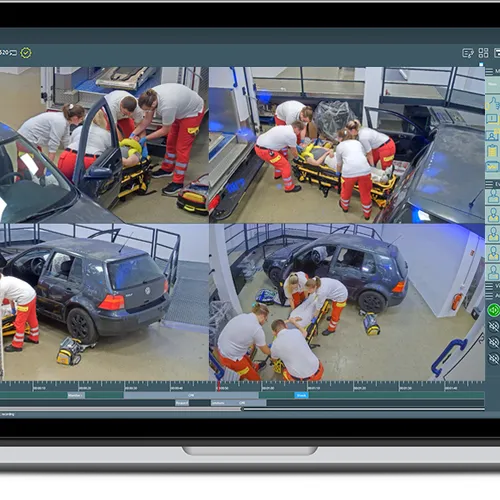
Structured Video Debriefing
Less preparation, more focused debriefings: instant access to relevant scenes.
Marker System
Set markers for important moments during training and jump directly to these points during debriefing.
Timestamped Comments
Add notes and observations directly linked to the corresponding moment in the video.
Structured Checklists
Discuss team performance along standardized CRM criteria with customizable checklists, the same way for every instructor.
Instant Playback
Show participants their actions immediately after the scenario, while impressions are still fresh.
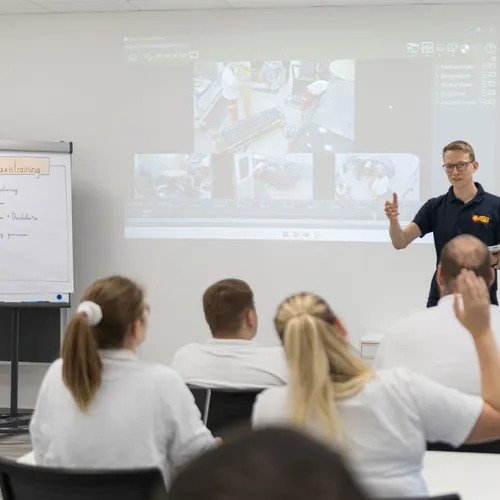
Realistic Emergency Scenarios
Train critical situations in a safe environment.
Emergency Scenarios
From resuscitation and trauma care to mass casualty incidents, train all relevant emergency situations.
Handoff Training
Practice the critical handoff from ambulance to emergency department or trauma bay.
Pediatric Emergencies
Rare but critical situations like pediatric emergencies can be trained in a protected environment.
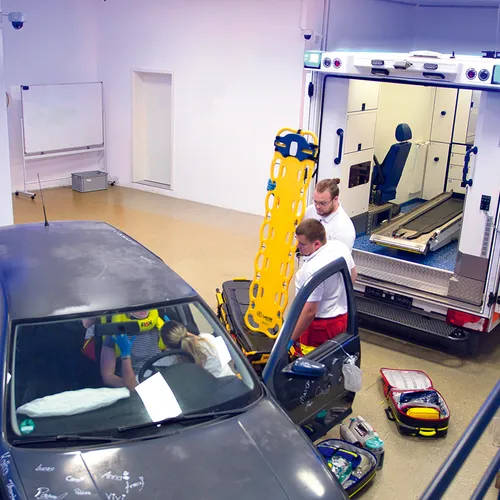
Mobile and Stationary Solutions
From the portable system for in-situ training to a fully equipped simulation center, matched to your training sites.
Portable Video Debriefing System
The mobile solution for flexible in-situ training directly at the point of care.
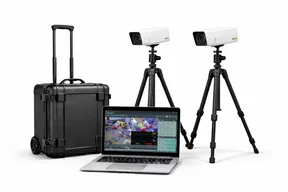

Quick Setup
The complete system is ready in minutes, ideal for training during ongoing operations.
Rugged Design
All components are housed in sturdy transport cases designed for mobile deployment.
Self-Contained Operation
Built-in storage and local processing enable operation without network infrastructure.
Stationary Simulation Center
Professional fixed installation for dedicated EMS training facilities.
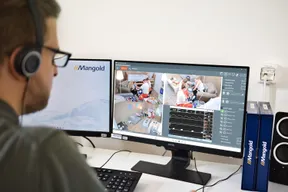
Separate Control Room
Monitor and control training from an adjacent room with complete system access.
Realistic Environment
Simulate various deployment environments, from ambulance to trauma bay.
Multi-Room Scenarios
Connect multiple rooms for complex scenarios like patient handoffs.
Use Cases
Video debriefing systems from Mangold International in EMS training.
Structured video debriefing as an integral part of paramedic programs, with learning progress documented across the entire training period.
Mandatory refresher training for EMS personnel with documented learning outcomes through video analysis.
One-day simulation training to improve team communication and error culture.
Analysis of critical incidents and near-misses for continuous improvement.
What Your Program Can Rely On
The quote covers everything your program needs to operate, from the system case to onboarding. No hidden costs.
You set up new scenarios, markers and checklists yourself within the system design. Not every change request turns into an invoice.
Service, updates and extensions remain available for years. The system also runs without a service contract.
No cloud. Recordings are stored GDPR-compliant and fully on-premise, and the mobile case runs self-contained without a network.
Development and Support, as a Paramedic School Sees It
Thomas Maier, Head of School
Vocational School for Paramedics, Burghausen
" Mangold VideoSyncPro is an important component for recording, analyzing, and post-processing our simulations. New requirements are implemented regularly, and the fast and excellent support has ensured smooth training operations for years. "
Video Debriefing Systems for EMS Training
From the system case for the ambulance to the multi-room simulation center. Every system can be adapted and extended later.
Portable System
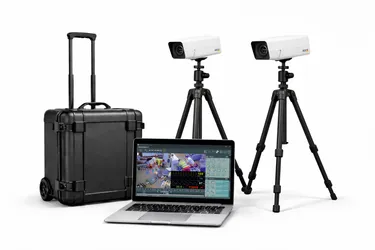
The mobile solution for flexible in-situ training - ideal for use directly in the ambulance or on location.
-
The easiest way to professional video debriefing...
-
Multi-Camera Recording
Synchronized recording of 2-3 HD cameras for various perspectives.
-
Professional Audio
High-quality audio recording of team communication with boundary microphone.
-
Marker System
Set markers during training for quick access to important scenes.
-
Instant Debriefing
Immediate playback after the scenario for maximum learning effect.
Stationary System
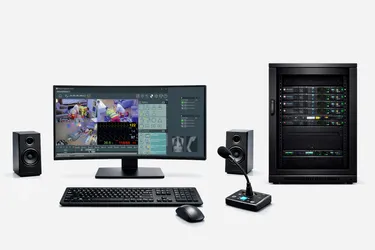
The professional solution for dedicated training rooms with separate control room.
-
Everything from portable system plus...
-
Advanced Camera Control
PTZ cameras with remote control for flexible perspectives during training.
-
Patient Monitor Integration
Synchronous recording of vital signs and ECG data.
-
Control Room Setup
Complete control from a separate observation room.
-
Network Streaming
Live streaming to additional observers or training rooms.
Multi-Room System
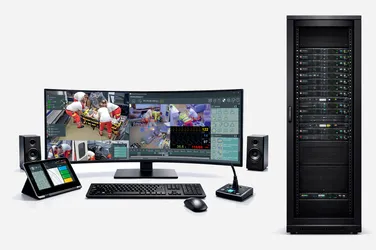
The premium solution for simulation centers with multiple networked training rooms.
-
Everything from stationary system plus...
-
Multi-Room Management
Centralized control of multiple simulation rooms from a single interface.
-
Handoff Scenarios
Connect ambulance, trauma bay, and emergency room for realistic handoffs.
-
Studio Mode
Seamless switching between cameras from different rooms during recording.
-
Advanced Analytics
Detailed analysis of response times and team interactions.
From Memory to What Actually Happened, on Every Training Call
See in a free demo how your school captures learning moments in the ambulance and plays them back in the debriefing with a single click. Or talk to us first about your training sites.
Frequently Asked Questions
What is in-situ simulation in EMS?
In-situ simulation means paramedics train under realistic conditions at the actual operational location, for example in the actual ambulance, emergency department or trauma bay. The mobile recording system from Mangold International captures these trainings and enables precise debriefing right on site.
Can the system record patient monitor data?
Yes. Patient monitors are integrated via HDMI, DVI or video input, synchronized into the recording. Vital signs, ECG and ventilator data appear alongside camera footage in real time, which is especially helpful for resuscitation and trauma scenarios.
How quickly can the mobile system be deployed in an ambulance?
The portable system is ready in minutes, requires no external infrastructure and can be deployed directly in ambulances, trauma bays or at in-situ training sites. The rugged trolley case contains all components including battery backup.
Which international training standards are supported?
The system documents how TCCC (Tactical Combat Casualty Care), ATLS (Advanced Trauma Life Support), PHTLS (Pre-Hospital Trauma Life Support), AMLS (Advanced Medical Life Support) and ITLS (International Trauma Life Support) are applied in your trainings, with checklists as a learning structure and PDF reporting.
Which scenarios are typically trained?
Common scenarios include resuscitation and defibrillation, polytrauma management, pediatric emergencies, anaphylaxis, airway management, ambulance-to-ED patient handoff (handoff communication), mass casualty incidents (MCI) and CBRN response.
Is the system suitable for EMS schools?
Yes. Vocational schools for paramedics use systems from Mangold International for structured training, regular continuing education and skills certification. Recordings and checklists document learning progress throughout the entire training period.
How do we handle students feeling under pressure from the camera?
The video is there to trace the call together, not to judge the person. The debriefing discusses, for example, which information was passed on at handoff and which was missing. Recordings stay on-premise, and your school decides who can access them and when they are deleted.
Can the system be adapted to new training sites and scenarios later?
Yes. You adapt scenarios, markers and checklists yourself within the system design, without paying for every change. Additional cameras or a second system case can be added. Service and updates are an offer, not a requirement for operation.