

Know-How · 11 min read
What is Happiness? Biometrics in Product Marketing 2026: A Scientific Perspective
Discover how consumer neuroscience and biometric methods like EEG, fNIRS, and EDA are used to measure consumer happiness. A scientifically grounded look at hedonia, arousal dynamics, and ethical boundaries in product marketing.

Can We Really Measure Consumer Happiness? A Look at the Science Behind the Smile
For decades, market researchers have relied on surveys to ask a seemingly simple question: Are you happy with this product? But human emotion is notoriously difficult to capture through retrospective self-reporting. Today, the growing field of consumer neuroscience is shifting the paradigm by measuring the physiological correlates of affective processing directly.
Instead of treating "happiness" as a single, vague metric, modern neuromarketing research deconstructs it. We look at the interplay between hedonia (momentary pleasure) and eudaimonia (deeper meaning), mapping how these experiences activate specific neural networks, such as the orbitofrontal cortex.
But how do researchers translate these complex brain states into actionable insights? The answer lies in multimodal biometrics. By combining high-resolution tools like EEG (to track approach motivation via frontal alpha asymmetry) and fNIRS (to monitor prefrontal cortex activation), alongside peripheral measures like Electrodermal Activity (EDA) and Facial Expression Analysis (FEA), researchers can capture the dynamic ebb and flow of emotional arousal in real-time.
Recent studies demonstrate that it is often the peak arousal-rather than a constant state of mild satisfaction-that best predicts purchasing behavior. Yet, this technological capability brings significant methodological caveats. Biometric markers are correlates, not direct proof of subjective feelings, and their interpretation must account for cultural differences and strict ethical boundaries (such as the EU AI Act).
Read the full article to explore the rigorous methodologies, the limitations of current technologies, and how an evidence-based approach to biometrics is helping designers move from merely measuring consumers to actively designing for human well-being.
The neuromarketing industry is experiencing significant growth, projected to expand from USD 1.45 billion in 2024 to USD 3.83 billion by 2034 [1]. This expansion reflects the increasing interest of companies in moving beyond traditional, often error-prone self-reports (surveys) to capture affective responses directly. Consumer neuroscientists utilize biometric methods to systematically analyze reactions to products. By measuring neural and physiological indicators, they can gain deeper, often subconscious insights into the affective perception of consumers. This article examines the scientific foundations, methodological approaches, and ethical implications of operationalizing and measuring “happiness” in the context of product marketing.
What is Consumer Neuroscience?
Consumer neuroscience refers to the application of neuroscientific methods (e.g., EEG, fNIRS, EDA) to analyze affective and cognitive responses to marketing stimuli and product experiences [2]. The goal is to understand the neurobiological mechanisms underlying consumer behavior.
What is Happiness Really? A Multidimensional Perspective
Before measurements can be conducted, the construct to be measured must be rigorously operationalized. In cognitive neuroscience and affect research, emotional experience is typically described along multiple dimensions, particularly valence (pleasantness vs. unpleasantness) and arousal (intensity of excitement). Happiness, however, cannot be reduced to a single point in this two-dimensional space. Positive psychology conceptually distinguishes between two central components of well-being:
Hedonia describes the experience of joy, pleasure, and momentary gratification. This refers to the immediate, affective component of happiness, often characterized by the absence of pain and the presence of positive affect.
Eudaimonia, on the other hand, describes a deeper sense of meaningfulness, engagement, and self-realization. This refers to a “life well-lived” that extends beyond momentary pleasures and is often linked to long-term goals and values.
Empirical studies show that these two aspects overlap significantly in happy individuals. A comprehensive investigation found that hedonic and eudaimonic motives occupy both overlapping and distinct niches within a complete picture of well-being [3]. Analyses of survey data indicate that approximately 80 percent of individuals who report high hedonic satisfaction also exhibit a high level of eudaimonic fulfillment [4]. This suggests that the neurobiological foundations of pleasure could be a crucial methodological gateway to understanding general well-being. However, it is scientifically imperative to emphasize that hedonia and eudaimonia remain conceptually distinguishable, and the presence of one does not necessarily causally determine the other [5].

What Does Happiness Look Like in the Brain?
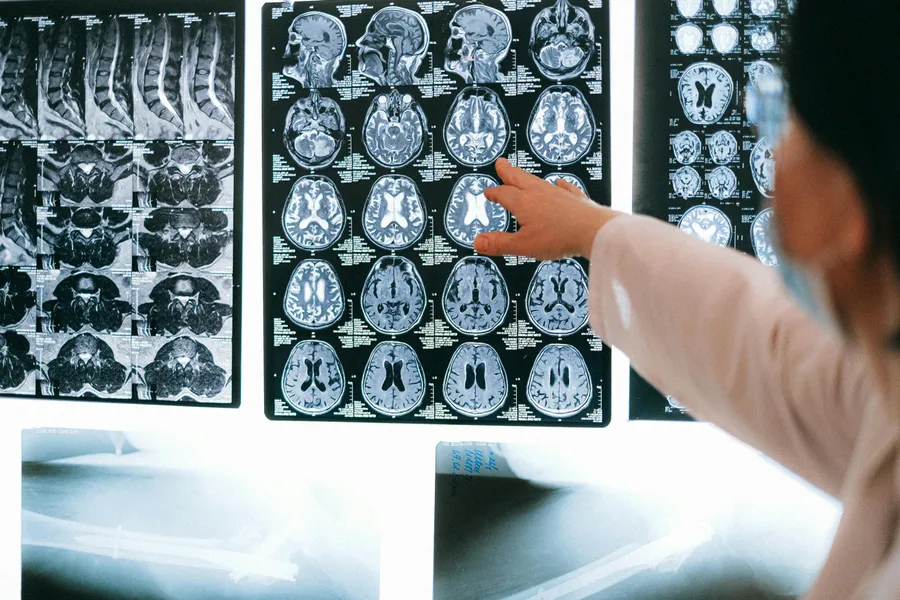
The notion of a single, isolated “happiness center” in the brain is considered obsolete in modern neuroscience. Instead, positive affective experience is constructed through a distributed network of interacting brain systems. Research has identified specific regions, particularly in the prefrontal cortex, that are significantly involved in hedonic processing [6].
| Brain Region | Associated Function in Hedonic Processing |
|---|---|
| Orbitofrontal Cortex (OFC) | Encoding of subjective reward and pleasantness of stimuli [6] |
| Frontal Pole | Maintenance of a sustained hedonic tone, e.g., when enjoying food or music |
| Medial Prefrontal Cortex | Processing of satisfaction and self-referential evaluation |
| Dorsolateral Prefrontal Cortex | Cognitive modulation and evaluative control of emotions |
Pleasure is not measured in the brain as a single, uniform signal, but rather as a complex interplay of sensory processing, emotional engagement, and evaluative judgment. Remarkably, neuroscientific studies show that higher, more abstract pleasures (such as social recognition or aesthetic enjoyment) partially recruit the same fundamental hedonic circuits as primary sensory pleasures (such as food) [6]. This makes these networks a valuable and valid subject of investigation for consumer neuroscience.
How Can Happiness Be Measured? The Tools of Consumer Neuroscience
Consumer neuroscience does not measure “happiness” as an abstract concept per se, but rather the neurophysiological indicators that empirically correlate with affective processing. The methodological key lies in a multimodal approach that combines various physiological data streams to obtain a more holistic and reliable picture.
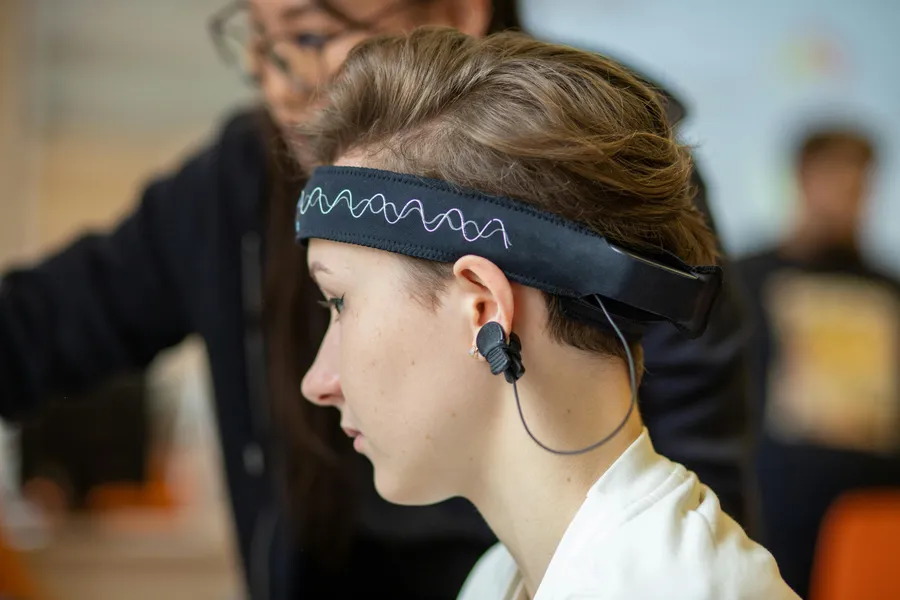
Electroencephalography (EEG) measures the electrical activity of the brain at the scalp with very high temporal resolution (in the millisecond range). Important markers for analysis include frontal alpha asymmetry (FAA), which is frequently associated in research with approach motivation and positive affect [7]. Another established marker is the Late Positive Potential (LPP), an event-related potential component that indicates emotional evaluation and sustained, motivated attention [8].
Functional Near-Infrared Spectroscopy (fNIRS) measures hemodynamic responses (oxygen supply) in the brain and provides information about the spatial localization of cortical activation. Due to its relative portability, fNIRS is particularly useful for consumer neuroscience to map activity in the aforementioned prefrontal regions during more realistic product experiences [9].
Peripheral Biometrics provide valuable insights into the activation of the autonomic nervous system, complementing cortical activity. Electrodermal activity (EDA) measures changes in skin conductance, which directly correlate with the arousal of the sympathetic nervous system [10]. Heart rate variability (HRV) and automated Facial Expression Analysis (FEA) capture additional dimensions of the emotional response, with FEA in particular providing clues to the valence of the emotion [11].
Machine Learning is increasingly being used to integrate these complex, high-dimensional datasets. Studies applying machine learning to multimodal biometric data (e.g., a combination of EDA and FEA) report classification accuracies of over 80% in predicting consumer preferences [12]. However, it must be noted with scientific caution that such predictive models are based on statistical correlations and do not prove direct causal mechanisms for the subjective experience of happiness.
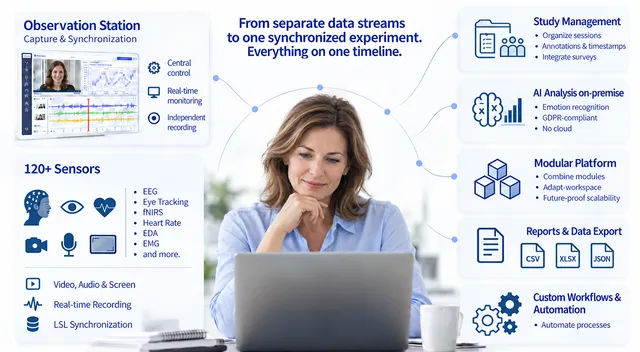
Research platforms such as Mangold Observation Studio are purpose-built for exactly this kind of multimodal data collection-synchronizing EEG, fNIRS, EDA, eye tracking, and video capture within a single integrated environment, which is a prerequisite for the cross-modal analyses described above.
Customer Experience Reimagined: How Emotional Patterns Predict Purchases
A significant methodological limitation of traditional survey methods is their static nature. A survey at the end of an experience only captures a retrospective, cognitively overlaid snapshot. Emotional responses, however, are inherently dynamic. A recent empirical study in the Journal of Business Research investigated the dynamics of emotional arousal during a real shopping experience [13].
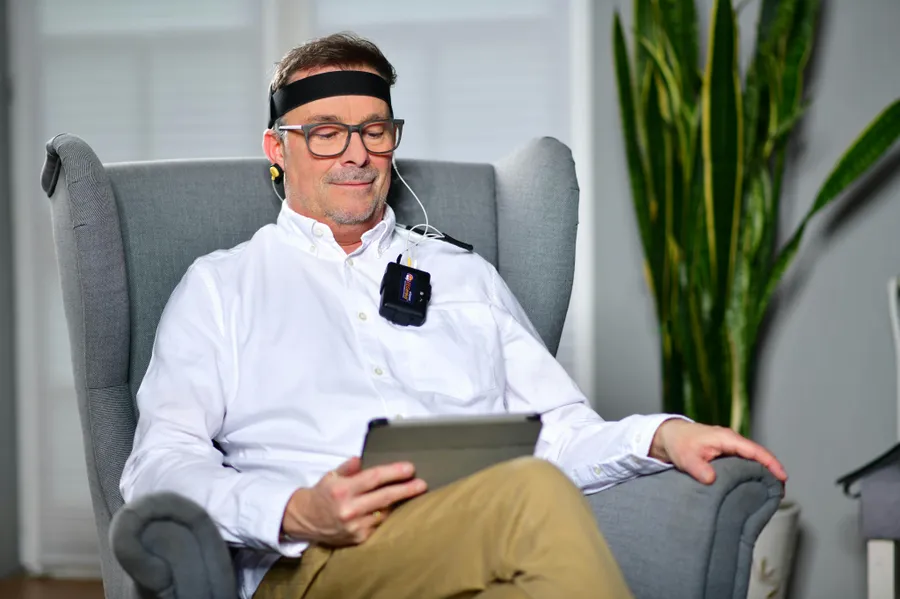
The researchers used mobile EDA sensors to continuously track the physiological arousal of customers in real-time. The results showed that it was not the simple average value of arousal, but specific dynamic patterns that predicted subsequent approach behavior (e.g., willingness to buy, unplanned spending):
- Peak Arousal: The highest level of arousal reached during the entire experience had a significant predictive impact. This provides physiological evidence consistent with the psychological peak-end rule described by Kahneman [14].
- Arousal Distribution: The statistical skewness of the arousal distribution-i.e., whether customers experienced predominantly low or punctually high arousal states-was also a significant predictor of purchasing behavior [13].
These empirical findings strongly suggest that deliberately designing the temporal “emotional journey” of a customer-with appropriately orchestrated physiological peaks and valleys-might be more behaviorally relevant than attempting to maximize a constant, moderate state of satisfaction.

Where Are the Limits of Happiness Measurement? Ethics and Culture
The technological ability to precisely measure emotional correlates comes with significant ethical and regulatory responsibility. The societal and legal debate regarding the ethics of automated emotion recognition is highly current. The European Union’s Artificial Intelligence Act (AI Act), which entered into force in August 2024, explicitly prohibits the use of AI systems for emotion recognition in the workplace and in educational institutions. In other commercial contexts, such biometric systems are often classified as high-risk applications subject to strict transparency and documentation requirements [15]. Primary scientific and societal concerns relate to data privacy, the potential for subconscious manipulation, and algorithmic bias.
Furthermore, from a psychological perspective, it must be emphasized that happiness is not a universal, culture-free construct. Cross-cultural research shows significant cultural differences in the definition, evaluation, and normative expression of happiness. While individualistic cultures (e.g., in North America) often emphasize and strive for high-arousal positive affect, collectivistic cultures (e.g., in East Asia) tend to place more value on calm satisfaction (low-arousal positive affect) and social harmony [16]. A standardized “one-size-fits-all” measurement of happiness indicators is therefore highly susceptible to cultural biases and can lead to invalid conclusions if the cultural context is not integrated into the analytical model.
Scientific Caveat on Validity
Methodologists consistently emphasize that no biometric method possesses 100% construct validity for subjective emotions. Every biometric indicator (such as EDA or EEG asymmetry) is merely a physiological correlate, not direct, infallible proof of a specific subjective feeling. The interpretation of biometric data must always be context-dependent and rigorously examine alternative explanations for physiological arousal (e.g., cognitive effort or stress instead of joy).

What Does the Future of Product Experience Look Like? From Measurement to Design
The growing understanding of the neurobiological correlates of positive affect enables a methodological paradigm shift in marketing: from a reactive approach (post-hoc customer surveys) to a proactive, physiologically informed design. By empirically understanding which specific design elements, interactions, or sensory stimuli reliably trigger neural patterns of joy, experiences can be systematically designed to promote user well-being.
The potential fields of application for this evidence-based design are diverse, and tools like Mangold Observation Studio provide the laboratory infrastructure to conduct this kind of research systematically and reproducibly:
- Product Design: Evidence-based development of products whose physical and functional properties have a measurably hedonic appeal.
- User Experience (UX): Design of digital interfaces whose interaction design demonstrably induces intuitive joy (positive affect), rather than merely minimizing cognitive friction (frustration).
- Advertising Effectiveness Research: Creation and pre-testing of campaigns for their ability to evoke authentic and behaviorally relevant physiological arousal patterns.
- Service Design: Design of physical customer experiences with an emotional dramaturgy that creates measurable physiological peaks (peak arousal) at strategically correct touchpoints.

Conclusion: Toward an Evidence-Based, Empathetic Market?
The operationalization and measurement of consumer happiness using consumer neuroscience and biometrics moves the discipline away from sole reliance on one-dimensional, retrospective satisfaction scales. It paves the way for a dynamic, multimodal, and physiologically grounded understanding of affective responses. The methodological combination of cognitive neuroscience, peripheral biometrics, and advanced machine learning offers tools of previously unattainable temporal and predictive precision.
The true scientific and societal progress, however, lies in the attitude with which these tools are applied. The primary goal should not be the seamless physiological measurement of consumers for pure profit maximization, but rather a deeper, empirically grounded understanding of the human experience in the consumption context. It is about integrating evidence-based empathy into the design process and creating products and services that not only fulfill functional market needs but also make a measurable, positive contribution to human well-being-while strictly observing ethical and cultural boundaries.
FAQ - Frequently Asked Questions
What is the difference between hedonia and eudaimonia in happiness research?
Which brain regions are involved in hedonic processing?
What biometric methods does consumer neuroscience use to measure happiness?
Why do peak arousal and arousal distribution predict purchasing behavior better than averages?
What are the ethical and cultural limits of emotion measurement in marketing?
How can neurobiological insights improve product and UX design?
Mangold Observation Studio
The advanced software suite for sophisticated sensor data-driven observational studies with comprehensive data collection and analysis capabilities.

References
[1] Market.us. (2024). Global NeuroMarketing Market Size, Share & Trends Analysis Report.
[2] Bazzani, A., Ravaioli, S., Trieste, L., Faraguna, R., & Turchetti, G. (2020). Is EEG Suitable for Marketing Research? A Systematic Review. Frontiers in Psychology, 11, 594566.
[3] Huta, V., & Ryan, R. M. (2010). Pursuing pleasure or virtue: The differential and overlapping well-being benefits of hedonic and eudaimonic motives. Journal of Happiness Studies, 11(6), 735–762.
[4] Berridge, K. C., & Kringelbach, M. L. (2011). Building a neuroscience of pleasure and well-being. Psychology of Well-Being, 1(1), 1–3.
[5] Waterman, A. S. (1993). Two conceptions of happiness: Contrasts of personal expressiveness (eudaimonia) and hedonic enjoyment. Journal of Personality and Social Psychology, 64(4), 678–691.
[6] Kringelbach, M. L. (2005). The human orbitofrontal cortex: linking reward to hedonic experience. Nature Reviews Neuroscience, 6(9), 691–702.
[7] Allen, J. J. B., Keune, P. M., Schönenberg, M., & Nusslock, R. (2017). Frontal EEG alpha asymmetry and emotion: From neural underpinnings and methodological considerations to psychopathology and social cognition. Psychophysiology, 55(1), 38–50.
[8] Dennis, T. A., & Hajcak, G. (2009). The late positive potential: a neurophysiological marker for emotion regulation in children. Journal of Child Psychology and Psychiatry, 80(5), 1120–1133.
[9] Krampe, C., Gier, N. R., & Kenning, P. (2018). The Application of Mobile fNIRS in Marketing Research-Detecting the “First-Choice-Brand” Effect. Frontiers in Human Neuroscience, 12, 434.
[10] Caruelle, D., Gustafsson, A., Shams, P., & Lervik-Olsen, L. (2019). The use of electrodermal activity (EDA) measurement to understand consumer emotions–A literature review and a call for action. Journal of Business Research, 104, 146–160.
[11] Kakaria, S., Bigné, E., & Catala, A. (2023). Heart rate variability in marketing research: A systematic review and methodological perspectives. Psychology & Marketing, 40(12), 2465–2484.
[12] Marques, J. A. L., et al. (2025). Predicting consumer ad preferences: Leveraging a machine learning approach for EDA and FEA neurophysiological metrics. Psychology & Marketing.
[13] Caruelle, D., Shams, P., Gustafsson, A., & Lervik-Olsen, L. (2024). Emotional arousal in customer experience: A dynamic view. Journal of Business Research, 170, 114344.
[14] Kahneman, D. (1999). Objective happiness. In D. Kahneman, E. Diener, & N. Schwarz (Eds.), Well-being: The foundations of hedonic psychology (pp. 3–25). Russell Sage Foundation.
[15] European Union. (2024). Regulation (EU) 2024/1689 of the European Parliament and of the Council laying down harmonised rules on artificial intelligence (Artificial Intelligence Act). Official Journal of the European Union.
[16] Diener, E., Oishi, S., & Lucas, R. E. (2003). Personality, culture, and subjective well-being: emotional and cognitive evaluations of life. Annual Review of Psychology, 54, 403–425.