

Product · 10 min read
Mangold INTERACT: Software for Video-Based Behavioral Observation and Coding
How Mangold INTERACT solves the central challenge of video-based behavioral observation: precise timestamps, overlapping events, iterative analysis, and integration of physiological data - methodologically grounded.
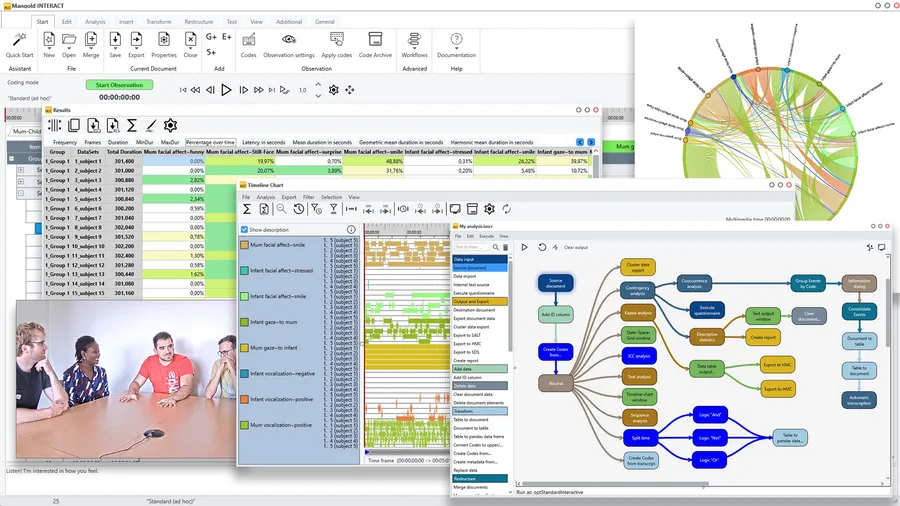
Mangold INTERACT is an internationally established standard for video-based behavioral observation and coding in research, teaching, and applied practice. For more than 35 years, the software has been used worldwide across scientific, clinical, and institutional settings and is recognized for its methodological precision, scientific rigor, and analytical reliability. Mangold INTERACT enables the systematic capture, time-precise coding, and differentiated analysis of behavior based on audio and video data. By supporting the integration of synchronized multimodal data streams, including physiological measures such as EEG or electrodermal activity, the software is well suited for complex research designs at a high scientific level. With features for inter-rater reliability, sequential and contingency analysis, and highly flexible coding schemes, Mangold INTERACT provides a robust and scientifically grounded platform for advanced observational research in psychology, medicine, education, ethology, and many other disciplines.
Mangold INTERACT: Video-Based Behavioral Observation at a Scientific Level
In video-based behavioral observation, the real challenge does not begin in front of the camera - it begins afterward. What unfolds in reality as a continuous flow of actions, reactions, and simultaneous events must be translated into a data structure that enables later analysis, without destroying the temporal relationships that lie at the heart of the research question. Mangold INTERACT was developed to solve exactly this problem in a methodologically sound way.
The software has been used for over 35 years in psychology, education, medicine, occupational science, and ethology - as a 360° research software built from the ground up around the demands of behavioral observation. This article describes the methodological decisions behind its design and their practical consequences for everyday research.
What Mangold INTERACT Does
At its core, Mangold INTERACT is a software for video-based behavioral coding and behavioral analysis. It accompanies the research process from the development of the coding scheme through the actual coding to the analysis - without requiring data to be exported to another program at any point, as long as the research question concerns temporal relationships in the observed behavior.
In concrete terms: Mangold INTERACT enables the time-synchronized playback of multiple audio and video files, parallel coding by multiple observers, calculation of inter-rater reliability, sequential and contingency analyses, and the temporal linking of physiological data - such as EEG signals or electrodermal activity measurements - with video material. The important temporal relationship between data points, which is typically lost when exporting to conventional statistical software, is maintained internally throughout - this is a fundamental methodological principle and a key advantage of Mangold INTERACT.
| Feature | Description |
|---|---|
| Timestamp precision of 100 nanoseconds | Highly precise timestamps enable exact assignment of every event to the corresponding video frame - relevant for frame-accurate analysis of fast or complex behavioral sequences. |
| Flexible coding schemes | Classes, codes, transcript fields, and lexical chains are freely definable - from simple nominal scales to recursively structured systems such as FACS. |
| All common sampling methods | Event sampling, time sampling, ad libitum, scan sampling, focal sampling - combinable freely within a single project. |
| Multi-stream synchronization | Simultaneous coding of multiple video and audio files with guaranteed temporal coherence across all data streams. |
| Workflow editor & Python integration | Automate and reproducibly document analysis pipelines using scripts - including specialized calculations such as HRV from raw data. |
| Iterative secondary analysis | Analysis results are written back as new, time-stamped events and are immediately available for further analyses. |
Fields of Application
Using software-based analysis tools in observational studies is generally preferable to paper-and-pencil methods - particularly when research questions concern when, how long, and in what relation to other behaviors an event occurs, whether and which behavioral patterns exist, and how the quality of observation can be assessed (e.g., inter-rater reliability). Mangold INTERACT is used in, among others:
- Developmental psychology & pediatrics: Mother-child interactions, early childhood development studies, early intervention
- Work & organizational psychology: Team communication, leadership behavior, meeting analysis, motivational interviewing
- Clinical research & therapy: Behavioral observation in intervention studies, pain research, psychiatric diagnostics
- Ethology & animal behavior: Long-term studies with time sampling, behavioral observation in natural and controlled environments
- Usability & human factors: Human-machine interaction, eye tracking integration, user studies
- Sports science: Movement analysis, technique assessment, tactical behavior
- Educational research: Classroom observation, learning behavior, interaction analysis in school settings
The Mangold INTERACT Data Model: Flexible and Precise Time Intervals
Most observation tools work with a continuous timeline: each newly recorded event implicitly marks the end of the previous one. This logic is practical for certain ethological study designs but assumes that behavior occurs continuously and in sequential order - an assumption that many research questions do not support.
Anyone who has tried to code overlapping behavioral sequences of multiple individuals in software that internally insists on a continuous timeline knows the problem: the model forces decisions that cannot be methodologically justified. Mangold INTERACT resolves this through a different foundational principle.
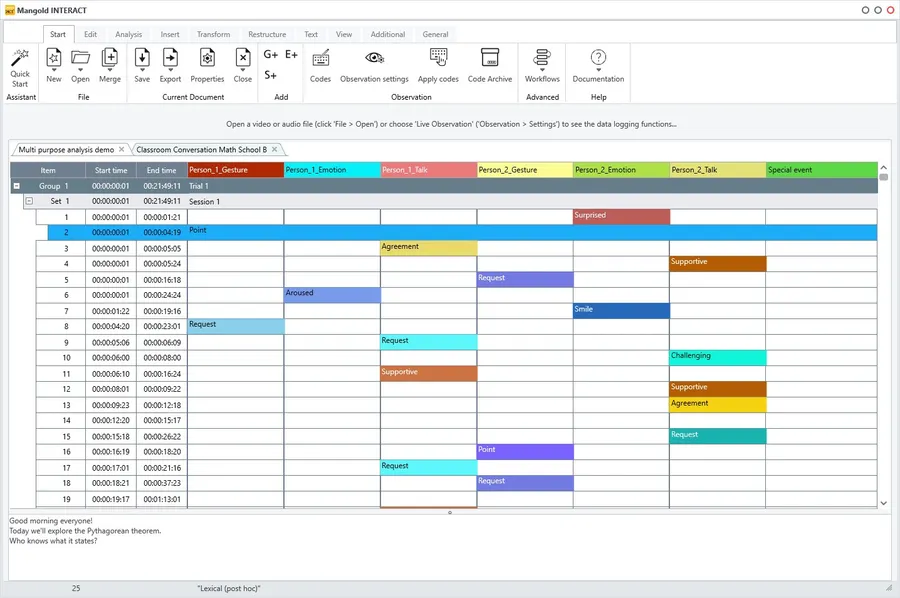
Every recorded data point - referred to internally as an event - has an explicit start time and an explicit end time. Each event is temporally independent of all others, can be modified at any time, filtered for analyses, and recombined with other data. When start and end time are identical, this corresponds to a momentary value in the sense of momentary time sampling. Mangold INTERACT is therefore method-agnostic and prescribes no particular sampling approach - it adapts to the study, not the other way around.
One practical consequence of this event-based approach: multiple coders can work in parallel on the same video material. One observer codes verbal utterances while a colleague simultaneously codes gaze directions. Both datasets can be analyzed independently and in exact temporal synchrony, without either coding influencing the other. For combined analysis, such datasets can simply be merged into a single file, since Mangold INTERACT automatically recognizes temporal relationships and supports any number of temporally parallel and overlapping events.
Mangold INTERACT stores timestamps with a precision of 100 nanoseconds. This may seem academic but is practically significant. At 25 frames per second (PAL standard), each frame lasts 40 ms; at 30 frames per second (NTSC standard), it is 33.3333333… ms. Systems that store timestamps as floating-point numbers in seconds can accumulate rounding errors that lead to incorrect results in statistical analyses or behavioral pattern searches - errors that remain invisible in the raw data and may only surface when scientific validity is at stake.
The flexibility, precision and proven record of worldwide use make Mangold INTERACT the Gold Standard for observational Research.
From Event to Insight: Iterative Analysis
Frequency and duration of codes are a sensible starting point - but the interesting questions in observational studies usually begin only afterward. What else is happening while two particular behaviors co-occur? How long does it take for a complex action to elicit a response? Does this latency change over the course of a therapy or a learning process? Such questions concern the temporal structure of behavior, not merely its raw frequency.
Mangold INTERACT addresses this through an iterative analysis principle: the results of one analysis step - for example, identified co-occurrence intervals - are written back as new, time-stamped events into the data. These secondary events are immediately available for further analysis. One can then ask what happens within the identified contingency intervals, use that result as the basis for yet another analysis, and so on. The temporal relationship is preserved at every step.
| Analysis function | Description |
|---|---|
| Co-occurrence analysis | Identification of simultaneously occurring codes; temporal distance between code A and code B |
| Sequential analysis | Lag-sequential analysis and pattern search across freely definable code combinations |
| Contingency analysis | Flexibly definable contingency windows; extraction and further analysis of contained code segments |
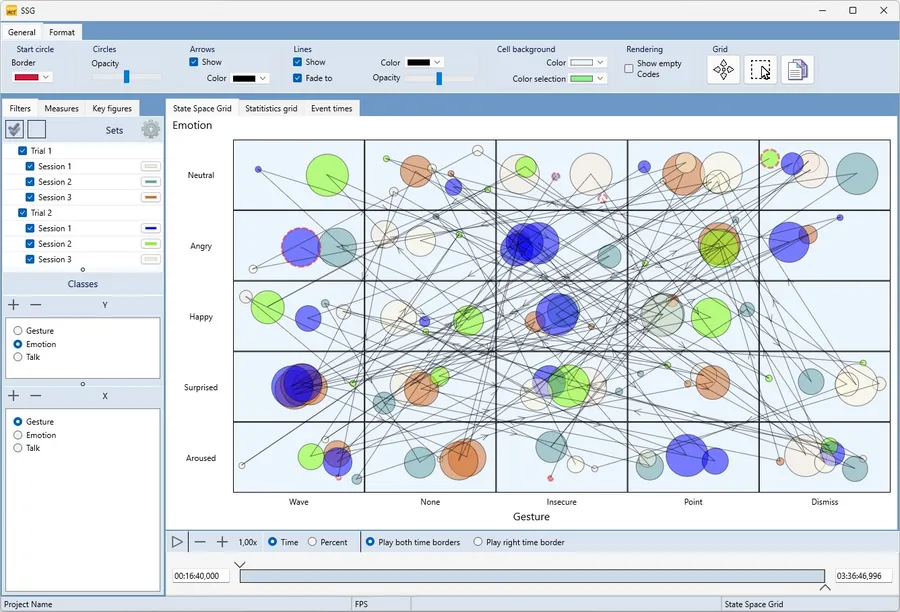
| State-space grids | Visualization of dynamic behavioral trajectories as spatial state lattices (following Hollenstein) |
| Inter-rater reliability | Calculation based on actual code overlaps, independent of interval boundaries |
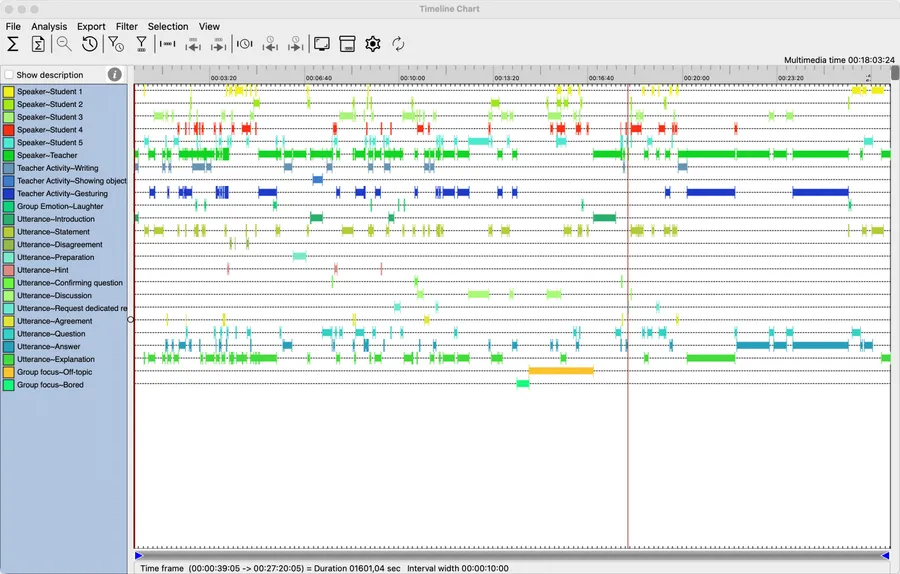
| Timeline visualization | Interactive timelines, chord diagrams, frequency charts - directly within the software |
| Python integration | Integrate custom scripts in the workflow editor - for specialized calculations and data manipulation |
A concrete example: “How long does it take, after the simultaneous occurrence of eye contact and a vocal utterance by person A, for person B to initiate contact - and does this latency change over the course of therapy?” This question requires that co-occurrences be identified, translated into time intervals, and used as context for a subsequent analysis. This is difficult to formulate with case-oriented statistical programs, because they typically do not preserve the temporal relationships between data points upon export.
“Mangold INTERACT has revolutionized our approach to data analysis, ensuring precision and real-time adaptability.” Heather Henderson, Prof. Ph.D., University of Waterloo, Canada
Coding Schemes: Structure as a Prerequisite for Reliability
A well-constructed coding scheme is not a formality - it determines which research questions can ultimately be answered with the collected data. Mangold INTERACT supports the development and application of such schemes, from simple nominal classes to hierarchically nested or recursively linked coding systems. The basic principle: codes are operational behavioral units that describe exactly one observable characteristic and are mutually exclusive (e.g., “eyes open,” “eyes closed” / or “pointing,” “grasping,” “writing”). Classes group thematically related codes together (e.g., “gesture,” “facial expression,” “mode of expression,” “emotion”).
The concept of lexical chains is particularly useful for efficient and effective coding: codes from multiple classes are combined into sequences during input, without requiring every possible combination to be defined in advance. This substantially reduces the cognitive load on coders - and with it the error rate. The Facial Action Coding System (FACS), for example, which encompasses a very large number of combinations of muscle, movement direction, and intensity, can be fully represented in Mangold INTERACT using three recursive classes, without requiring the coder to memorize hundreds of individual codes. When coding lexically, the coder simply enters the desired values - muscle, movement, intensity - in sequence, enabling fast and accurate coding of complex expressions.
That codes should be described using concrete behavioral terms - rather than numeric abbreviations that require an additional translation step - may seem obvious, yet is frequently neglected in practice. Mangold INTERACT makes it straightforward to define codes with descriptive labels (e.g., “Friendly,” “raises hand,” “open question” rather than “FR,” “RH,” “2”). This greatly facilitates learning (rater training) and practical application. Any descriptive code can be assigned a custom abbreviation or numeric value, so that codes are automatically converted to the desired shorthand upon data export if needed.
Integration into the Research Workflow
Behavioral observation data rarely stand alone - the coding results often need to be related to physiological measurements, eye tracking data, EEG signals, or electrodermal activity. In Mangold INTERACT, such external data sources can be temporally linked to the video material, so that behavioral sequences and biosignals can be analyzed on the same time axis.
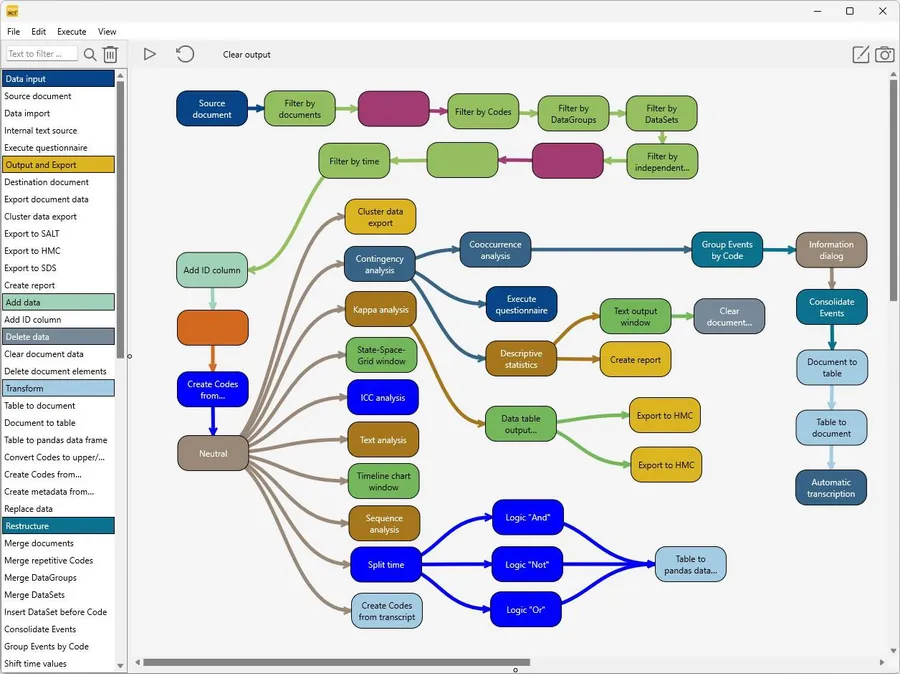
For recurring analysis processes, the workflow editor allows complex analysis pipelines to be configured and automated. Individual steps - data selection, transformation, analysis, export - are defined as nodes and can be extended with Python scripts. The result is a reproducible, documented process that is automatically available to all project members. Particularly in multi-site studies and in preparing for replicability, this is more than a convenience - it is a methodological necessity.
Choosing the Right Software
Which observation software is appropriate for a given project depends on the data structure the study design requires. Software built on the continuous timeline paradigm works well for designs in which gapless, non-overlapping state sequences describe behavior. Where parallel coding, overlapping codes, non-chronological capture, or the reintegration of analysis results into the data are required, such models encounter structural limitations.
The most useful question before starting a project is therefore not “Which software is most widely used?” but rather: which data structure and capture approach best represents the research question - and which analyses should be possible without data export and loss of information? Correcting this decision after the fact is, in practice, costly.
“Our experience with Mangold INTERACT was excellent. The software is friendly, intuitive to use, gives precise results and supports comprehensive behavioral pattern analysis.” Ruth Feldman, Prof. Ph.D., Best Female Scientist 2022, Expertscape World Expert, Herzlia Israel
Use in Research and Teaching
Mangold INTERACT is documented in a number of standard references on behavioral observation and group interaction research, including the Cambridge Handbook of Group Interaction Analysis (Glüer & Boos, 2018). The software appears as a data collection instrument in peer-reviewed publications from developmental psychology, organizational psychology, clinical research, and ethology - evidence that the data model genuinely works across disciplines, not just in theory.
Mangold International provides documentation, video tutorials, and technical support.
Mangold INTERACT: One Software for Your Entire Observational Research Workflow
From audio/video-based content-coding and transcription to analysis - Mangold INTERACT has you covered.


FAQ - Frequently Asked Questions
What is Mangold INTERACT and what is it used for?
In which research disciplines is Mangold INTERACT used?
How does Mangold INTERACT differ from other behavioral observation tools?
What behavioral observation sampling methods does Mangold INTERACT support?
Can Mangold INTERACT process multiple video and audio files simultaneously?
How precise are Mangold INTERACT timestamps?
What is a lexical chain in Mangold INTERACT and what is it used for?
How does iterative secondary analysis work in Mangold INTERACT?
What analysis functions does Mangold INTERACT offer?
Can Mangold INTERACT be combined with physiological measurement systems or eye tracking?
Does Mangold INTERACT support parallel coding by multiple observers?
Can Mangold INTERACT be combined with other analysis programs?
Can analysis workflows in Mangold INTERACT be automated?
For what type of study design is Mangold INTERACT particularly suited?
Can Mangold INTERACT be used for mixed-methods research?
Why do researchers choose Mangold INTERACT over other observational research software?
How is Mangold INTERACT documented in the scientific literature?
Where can I find more information, tutorials, and trial versions of Mangold INTERACT?
Mangold INTERACT: One Software for Your Entire Observational Research Workflow
From audio/video-based content-coding and transcription to analysis - Mangold INTERACT has you covered.