

Know-How · 7 min read
Video Debriefing in Simulation: How AV Systems Accelerate the Learning Curve
How video debriefing systems replace subjective impressions with objective facts – and accelerate the learning curve in simulation training centers.
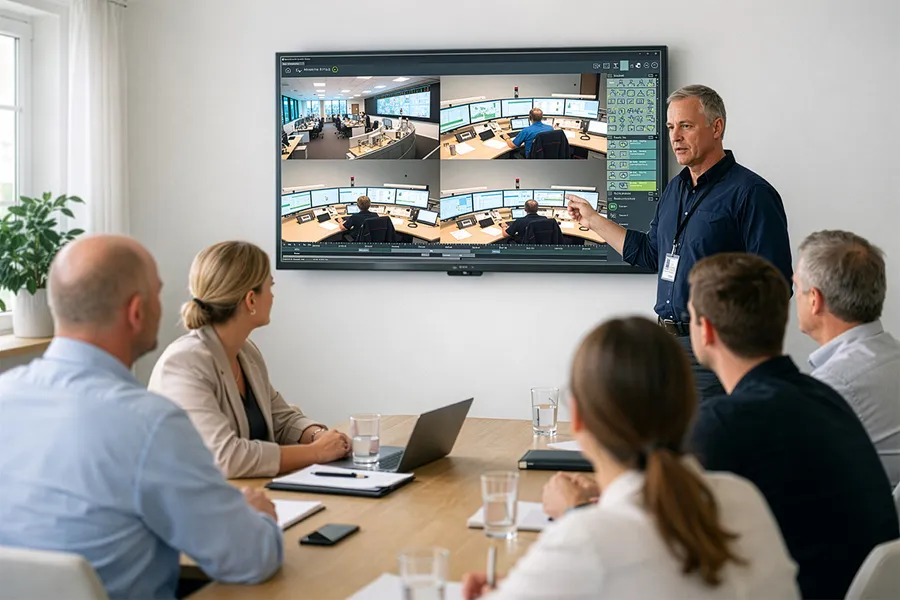

In the professional training of medical staff, emergency responders and security teams, simulation-based training has become the gold standard. Yet the real learning experience rarely happens during the simulation itself - it happens in the structured debrief that follows. When instructors rely solely on their own observations and on the participants memories, cognitive biases inevitably creep in. A professional video debriefing system solves this problem by replacing subjective impressions with objective, verifiable facts. This article reviews the scientific evidence behind video-assisted debriefing (VAD), introduces the methodological frameworks that have proven themselves in practice, and explains what simulation center operators should look for when selecting the right AV technology.
In the professional training of medical staff, emergency responders and security teams, simulation-based training has become the gold standard. Yet the real learning experience rarely happens during the simulation itself – it happens in the structured debrief that follows. When instructors rely solely on their own observations and on the participants’ memories, cognitive biases inevitably creep in.
A professional video debriefing system solves this problem by replacing subjective impressions with objective, verifiable facts. This article reviews the scientific evidence behind video-assisted debriefing (VAD), introduces the methodological frameworks that have proven themselves in practice, and explains what simulation center operators should look for when selecting the right AV technology.
What Is Video Debriefing in Simulation?
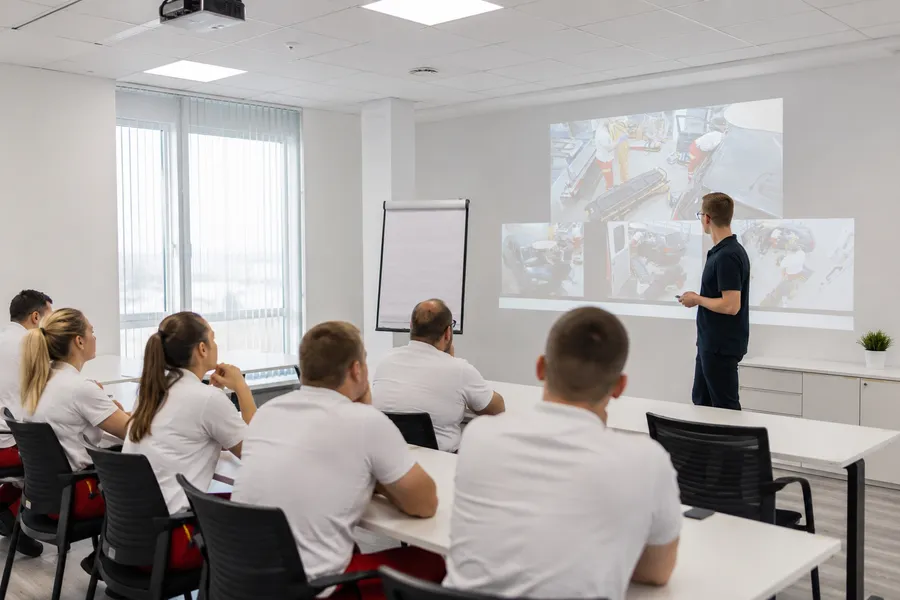
Video debriefing (also: video-assisted debriefing, VAD) refers to the process-guided use of audiovisual recordings to objectively review actions, communication and decision-making in simulation-based training scenarios.
Unlike a purely verbal debrief, a video debriefing system provides participants with an unalterable record of what they actually did. The conversation shifts from “who is right?” to “what actually happened?”. This objectification matters most in high-stress scenarios, where human perception is heavily distorted by what is commonly called tunnel vision.
The Scientific Evidence: Why Video Feedback Works
The superiority of video-assisted debriefing over purely verbal review is supported by a growing body of scientific publications. When learners observe their own actions on screen, a shift in perspective occurs that catalyzes critical self-reflection [1].
Overcoming Cognitive Biases
Under high stress – the kind deliberately created in realistic emergency scenarios – human perception narrows. Participants miss key elements of team communication or patient management without realizing it. A recent randomized trial by Rueda-Medina et al. (2024) shows that video-assisted debriefing after simulated clinical sessions significantly improves the debriefing experience, the simulation rating and the depth of reflection compared with purely verbal debriefing [2].
Lasting Retention of Learning Content
The learning effect of video feedback is not only immediate – it is durable. Systematic reviews show that video-playback-supported reflection produces positive effects on clinical performance months after the initial simulation [3]. Visual confirmation of correct actions strengthens self-confidence, while objective confrontation with mistakes forces deeper cognitive processing.
| Benefit of video debriefing | Scientific rationale |
|---|---|
| Objectivity | Eliminates hindsight bias through an unalterable recording |
| Shift in perspective | Dissociation from the actor role into the observer role supports metacognition |
| Micro-analysis | Complex sequences can be reviewed frame by frame or in slow motion |
| Psychological safety | Discussions are based on facts, not on blame |
| Long-term effect | Demonstrable effects on clinical performance months after the simulation [3] |
Established Debriefing Methods for Use With Video
The mere existence of a video recording does not guarantee learning. The technology unfolds its full potential only when it is embedded in a structured pedagogical framework. Two models have become widely established in the international simulation community.
The PEARLS Framework
PEARLS (Promoting Excellence And Reflective Learning in Simulation) is an integrated conceptual framework for a blended-learning approach to debriefing [4]. It structures the debrief into clearly defined phases, with video feedback applied where it adds the most value:
| Phase | Content | Role of the video system |
|---|---|---|
| Setting the Scene | Establish ground rules, create a psychologically safe environment | No active role |
| Reaction | Participants voice their first emotional reactions | No active role |
| Description | Factual summary of the clinical or tactical events | Video as memory aid when details are unclear |
| Analysis | Core of the debrief: resolving discrepancies between perception and reality | Targeted playback of marked sequences |
| Summary | Derive concrete take-home messages | Highlight clips for the wrap-up |
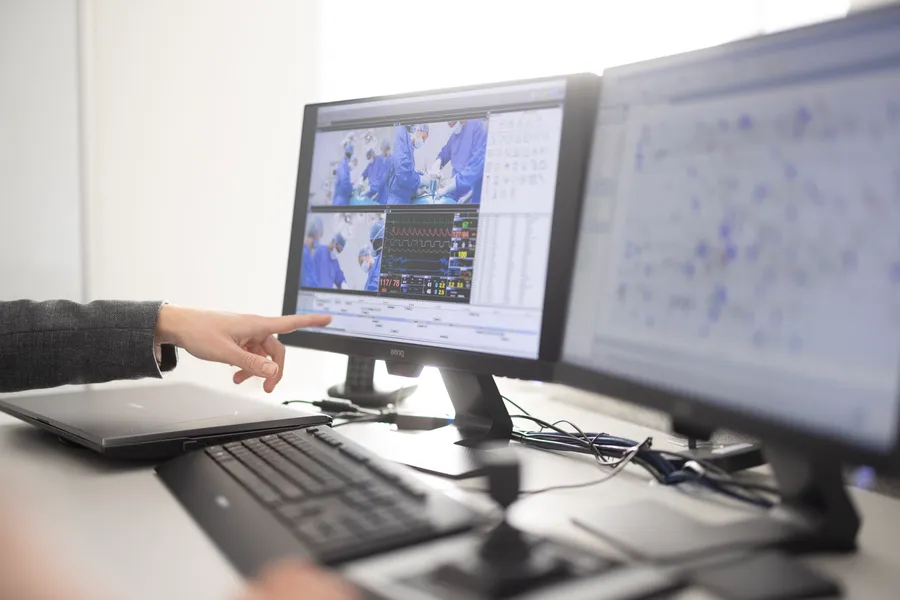
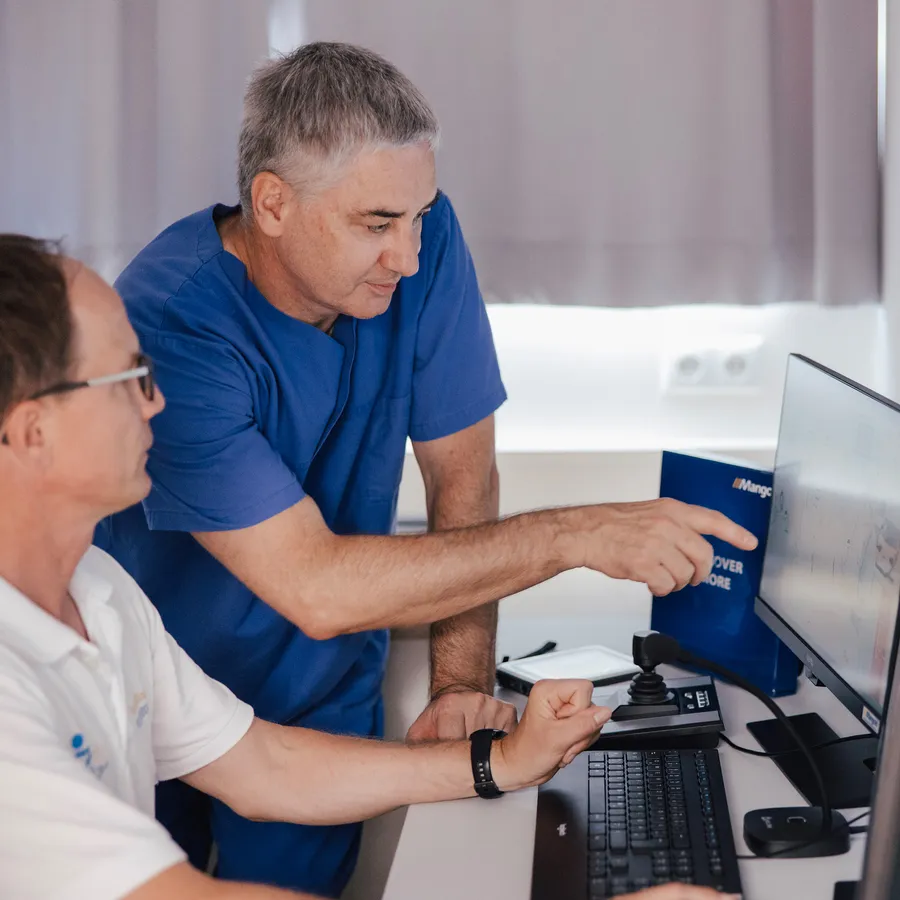
In the Analysis phase, the video system delivers its highest value. Markers set by the instructor during the running simulation allow an immediate jump to critical scenes – no scrubbing, no fast-forwarding.
The GAS Model
The GAS model (Gather, Analyze, Summarize) offers a more compact structure, particularly well suited to shorter scenarios or in situ training on the ward [5]. In the Analyze phase, the video serves as an objective witness to test assumptions and discuss alternative courses of action.
Technical Requirements: Technology Transferred From Research
A professional AV system for simulation centers is fundamentally different from a standard surveillance or conferencing setup. The demands on latency, synchronization and operability under time pressure are extreme.
This is where many generic AV vendors fall short. Mangold International has taken a different route: technology transfer from high-end research. For more than 35 years, Mangold International has built the Mangold INTERACT software and complex AV observation labs for scientific behavioral research – a field that tolerates neither asynchronous data nor imprecise recordings. That same uncompromising research-grade technology forms the foundation of Mangold International’s video debriefing systems today.
Synchronizing Multiple Data Streams
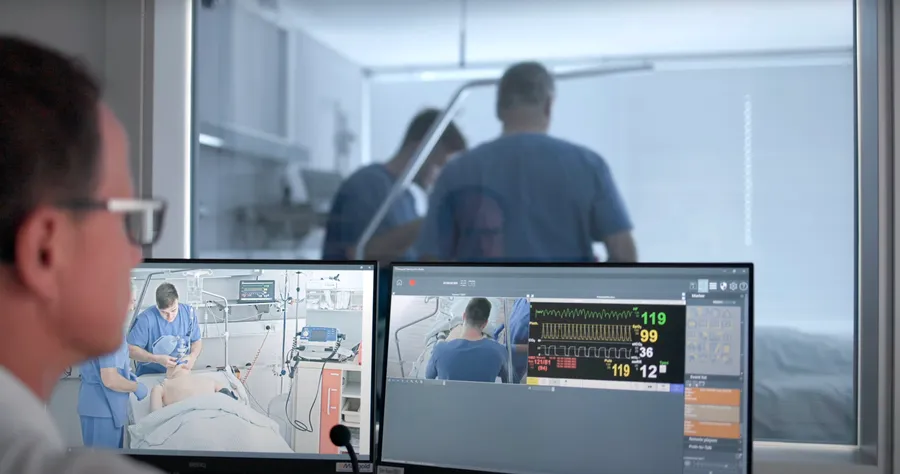
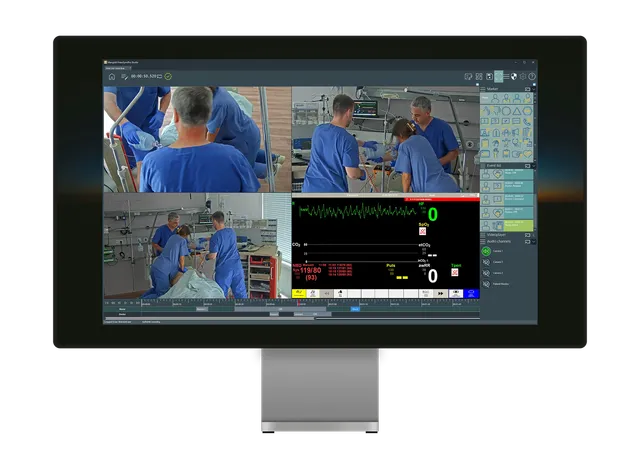
A complex medical simulation involves multiple data sources that must be recorded and replayed in sync. These include multiple camera angles (wide shot, close-up, team-leader perspective), room and radio microphones capturing team communication, vital signs from the patient simulator (ECG, SpO2, blood pressure) and system logs of the interventions performed.
If these streams drift out of sync even slightly, the debrief loses its credibility – because the exact temporal relationship becomes unclear. “Did action A happen before B, or after it?” – and that question needs second-by-second precision. When the system cannot answer it, the so-called fiction contract collapses – the learners’ willingness to accept the simulation as realistic [6].
Live Annotation and Intuitive Operation
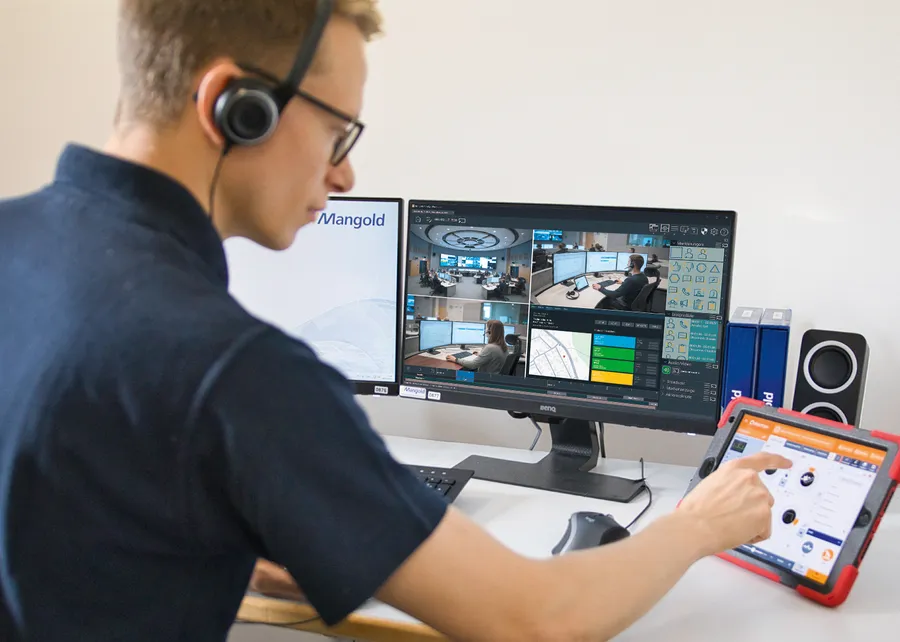
The instructor must be able to mark what is happening on the fly, with just a few clicks. A system like Mangold VideoSyncPro by Mangold International allows pre-defined events (e.g. “successful intubation”, “communication breakdown”, “medication administered”) to be tagged live. In the debrief that follows, the instructor can jump straight to those critical moments – no training time lost to searching.
Flexibility: Permanent and Mobile
Modern simulation programs are not confined to permanently installed simulation centers. In situ simulations on the ICU, in an ambulance or in a mobile command unit call for portable AV solutions – ones that work without elaborate infrastructure while delivering the same recording quality and synchronization accuracy.
Application Areas: Where Video Debriefing Makes the Difference
Video debriefing systems are used wherever teams have to make complex decisions under time pressure and where mistakes can have serious consequences.
| Application area | Typical scenarios | Specific benefit |
|---|---|---|
| Medical simulation | Resuscitation, trauma management, OR team training | Analysis of CRM (crew resource management) and closed-loop communication |
| Emergency medical services (EMS) | Paramedic training, mass-casualty (MCI) scenarios | Review of protocol compliance and team coordination |
| Police training | Tactical scenarios, de-escalation, use of force | Analysis of decision-making under stress |
| Dispatch and control room simulation | Radio communication, resource dispatching, crisis comms | Screen recording plus synchronized audio |
The Return on Investment (ROI) of Debriefing Software
The investment in professional simulation debriefing software has to be defended in front of budget holders. ROI in healthcare simulation is built from both measurable (tangible) and intangible factors [7].
Among the quantifiable benefits is a significant reduction in instructor effort. When participants can see their own mistakes on screen, lengthy persuasion conversations disappear. The learning curve becomes steeper, which means the net training time per cohort can be reduced.
Even more important are the long-term effects on patient safety. Centers that run high-quality, video-supported simulation training measurably record lower error rates in critical procedures – and a stronger safety culture overall.
| ROI dimension | Measurable effect |
|---|---|
| Training efficiency | Shorter debriefing times with greater reflection depth |
| Instructor workload | Less explanation required – the video carries the argument |
| Skill development | Steeper learning curve through immediate visual feedback |
| Patient safety | Reduction in critical errors through more durable learning |
| Quality assurance | Documented training performance for accreditation and audits |
The Bottom Line: Facts Over Opinions
Whether in medical simulation, dispatch training or police academies – decisions made in fractions of a second require training that leaves no room for evasion. A high-grade video debriefing system transforms the debrief from an opinion-based discussion into a fact-based analysis.
Integrating a robust, intuitively operable AV solution is therefore not optional accessory equipment for a simulation center – it is the technological foundation for sustainable skill development and maximum patient safety.
Video Debriefing in Medical Simulation
Explore Mangold video debriefing systems used in medical simulation training - supporting healthcare educators with structured, evidence-based feedback.
FAQ - Frequently Asked Questions
What is the difference between video debriefing and traditional debriefing?
Is video debriefing demonstrably more effective than verbal debriefing?
Which debriefing frameworks work well with video?
Which sectors benefit from a video debriefing system?
What does a video debriefing system cost?
Sources
Schertzer K. (2023). Use of Video During Debriefing In Medical Simulation. StatPearls Publishing. NCBI Bookshelf.
Rueda-Medina B, et al. (2024).
Effectiveness of video-assisted debriefing versus oral debriefing in simulated clinical sessions: A randomized controlled trial
. Clinical Simulation in Nursing.
Levett-Jones T, Lapkin S. (2014). A systematic review of the effectiveness of simulation debriefing in health professional education. Nurse Education Today.
Bajaj K, et al. PEARLS Healthcare Simulation Debrief. HealthySimulation.com.
Phrampus PE, O’Donnell JM. Debriefing Using a Structured and Supported Approach. The GAS Model. In: The Comprehensive Textbook of Healthcare Simulation.
Luna Lamas MA. (2026). Integration of Video-Assisted Debriefing Systems in Healthcare Simulation. HealthySimulation.com.
Asche CV, et al. (2018). A Framework for Determining the Return on Investment of Simulation-Based Training in Health Care. PMC / NIH.