
Know-How · 12 min read
Build a Focus Group Facility: The Complete Setup Guide
How to build a professional focus group facility for qualitative research: room layout, AV technology, eye tracking and analysis software – by Mangold.
A practical, end-to-end guide to building a modern focus group facility for qualitative research, product testing and UX studies – from room layout and AV equipment to synchronized recording and behavioral analysis software.
What Is a Focus Group Facility? One-Sentence Definition
A focus group facility is a purpose-built research environment with synchronized audio-video recording, designed to run focus groups, in-depth interviews, product tests and usability studies under controlled, observable conditions.
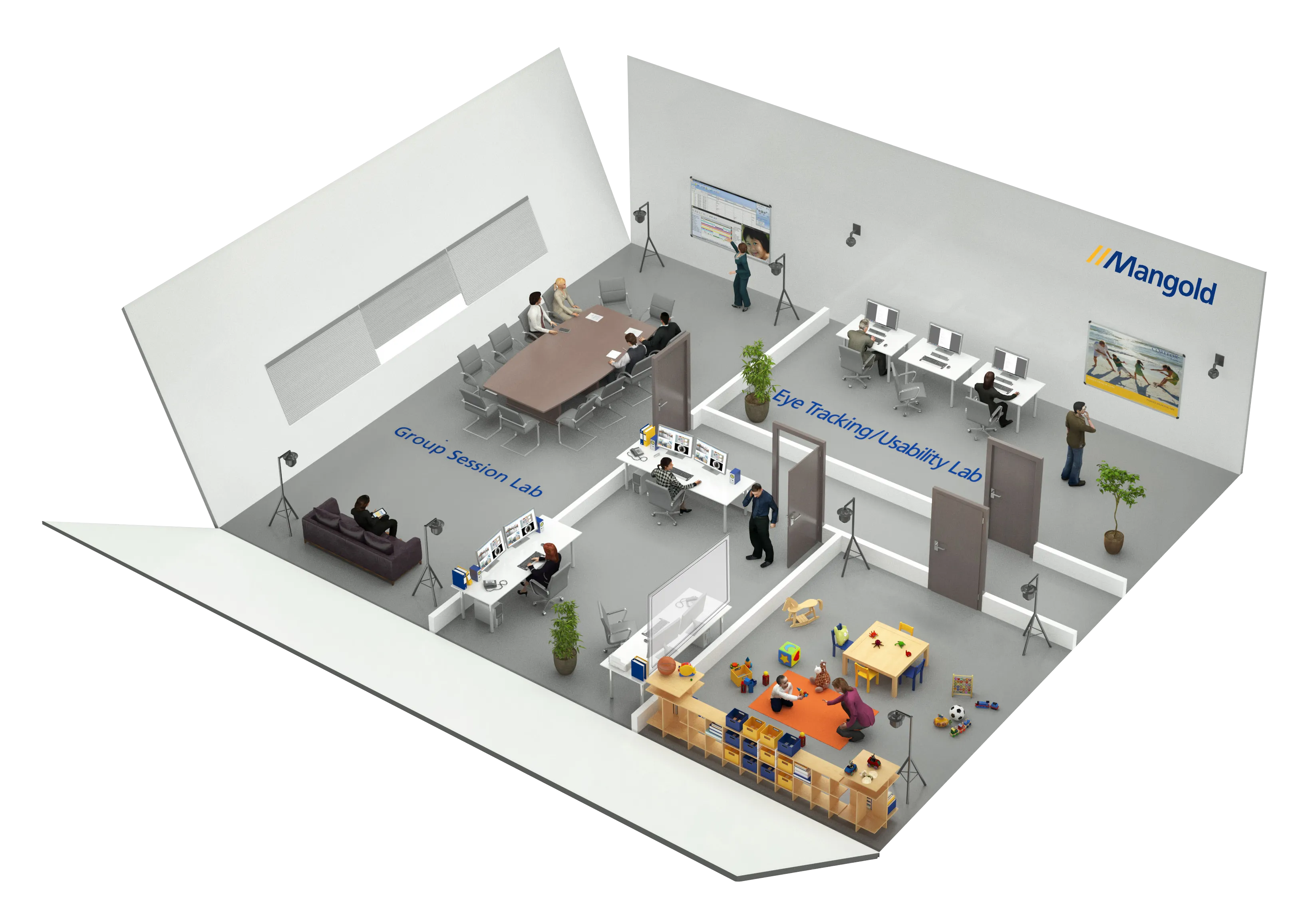
In academic and behavioral research, the same setup is often called an observation lab or behavioral research lab. At its core, the layout always involves two areas: a discussion room for participants and an observation room (also known as the back room or viewing room) for clients, moderators and researchers.
The quality of insight you can extract depends on two things: the physical AV setup and the software stack for recording, synchronization and analysis. Modern focus group facilities have moved well beyond simple video capture – they now integrate eye tracking, physiological sensors and AI-driven behavioral analysis.
Why the Classic Two-Way Mirror Is Outdated
For decades, the two-way mirror (also called a one-way mirror) was the default way to separate the observation room from the discussion room. In practice, however, this approach comes with substantial drawbacks:
- High cost for the mirror itself and even higher cost for the wall construction required to install it.
- Strict lighting separation: The observation room must stay darker than the discussion room at all times, or observers become visible.
- Psychological pressure on participants: People know they are being watched, which reduces the authenticity of their reactions.
- Architectural inflexibility: The two rooms must be physically adjacent.
- Latency between live observation and recording: When cameras are also installed, there is a visible delay between what observers see at the mirror and what appears on the recording monitors.
Our clear recommendation: skip the two-way mirror. Discreetly placed cameras combined with network-based AV transmission deliver equivalent – and often better – observation quality without the structural constraints.
The decisive advantage: the observation room can be located anywhere in the building. The discussion room and observation room only need to be connected by a single network cable that carries all audio, video and data streams. This solves the problem nearly every research institute knows well: “We don’t have two adjacent rooms available.”
The Anatomy of a Professional Focus Group Facility
The Discussion Room: Designed for Open Conversation
The discussion room – sometimes called the group room or GD room – is where the focus group takes place. It needs to invite participants into natural, open conversation. The essentials:
- Acoustics: Sound-absorbing surfaces and proper sound insulation for clean audio.
- Lighting: Neutral, glare-free and bright enough for high-quality video.
- Atmosphere: A living-room feel or a neutral, modern setting – free of visual distractions.
- Technology integration: Cameras and microphones placed as discreetly as possible.
The Observation Room: Comfortable Live Viewing
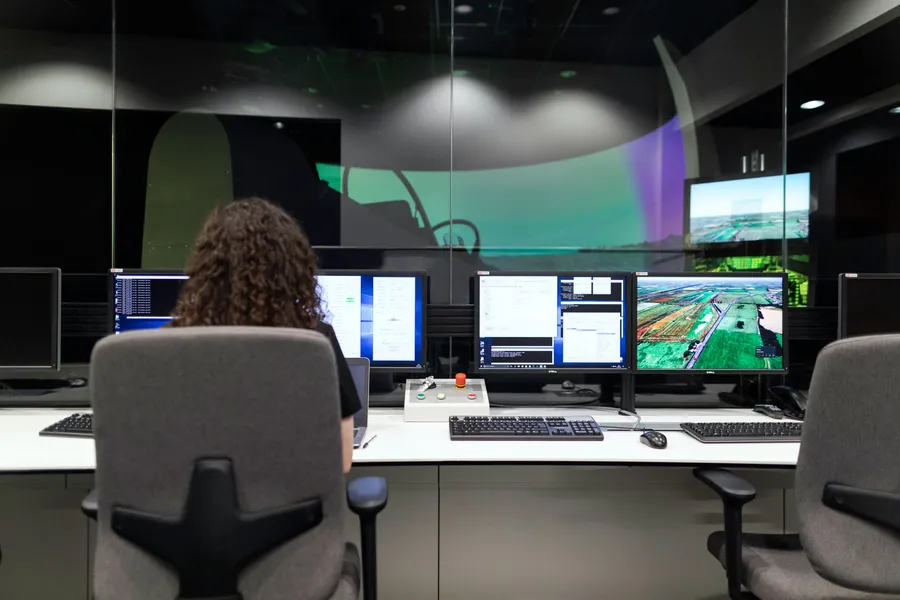
The observation room gives clients and researchers a real-time view of the session. Standard setup includes:
- multiple monitors with different camera perspectives,
- high-quality speakers with clear speech reproduction,
- a central control unit for cameras, microphones and recording,
- ergonomic workstations for several observers at once.
Multi-Room Configurations for Larger Institutes
For institutes running high study volumes, Mangold International recommends a multi-room configuration: several participant rooms connected to dedicated or shared control rooms, enabling parallel studies with clean data separation. See Mangold AV lab solutions for example configurations.
Permanent vs. Portable: Choosing the Right Setup
Two basic configurations make sense depending on use case, budget and study design:
| Feature | Permanent Facility | Portable Facility |
|---|---|---|
| Setup | Fixed installation, custom-built | Mobile, packed in transport case |
| Cameras | 4× PTZ cameras (remote-controlled) | 2× HD cameras (fixed or PTZ) |
| Microphones | Ceiling mic, push-to-talk | Boundary microphone |
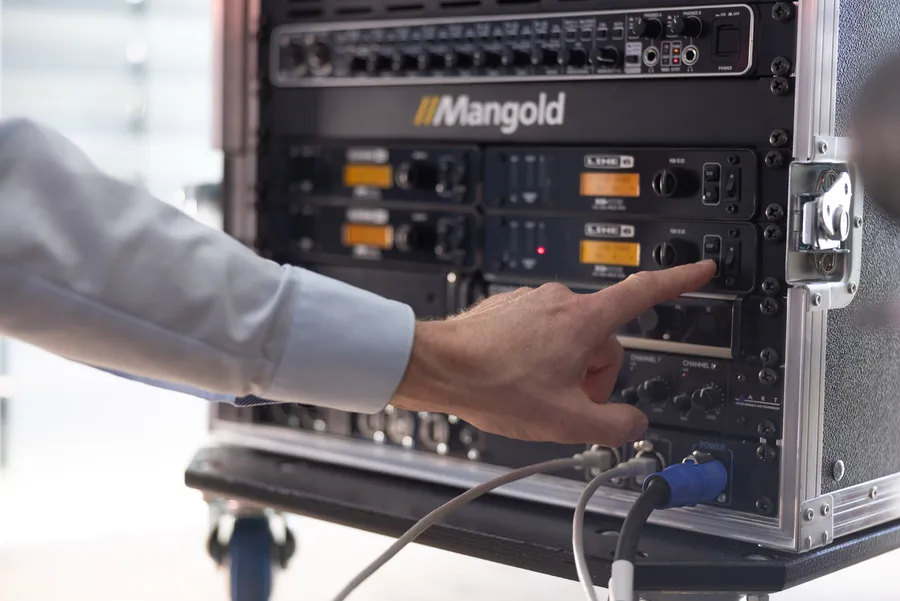
| Control | Dual-monitor workstation, 19″ rack | Laptop with wireless mouse |
| Use case | Long-term studies, fixed location | Field research, multi-site studies |
| Highlight | Dedicated observation room optional | Air-travel-ready, ~2-minute setup |
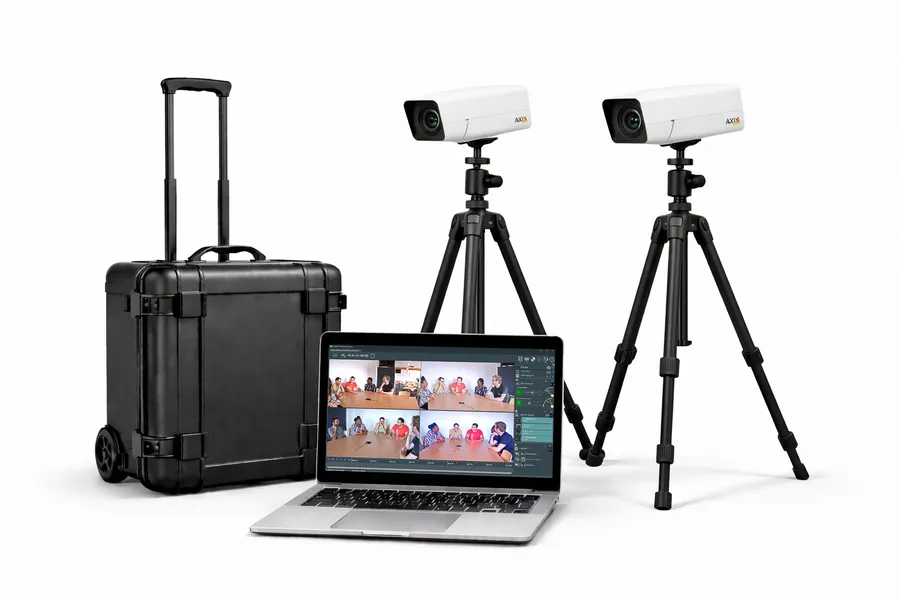
A portable observation lab lets market research firms run a fully equipped focus group facility on-site at the client’s location – a major advantage for studies that need to happen in natural consumer environments.
Audio and Video: The Technical Foundation
Professional Video Recording in a Focus Group Facility
Video is the data backbone of every qualitative study. High-resolution cameras capture facial expressions, gestures, body language and group dynamics – information no audio transcript can replicate. Mangold International builds on a carefully matched camera lineup:
- Fixed cameras are aimed at a defined area and offer a cost-effective option for clearly scoped observation scenarios.
- PTZ cameras (pan-tilt-zoom) can be panned, tilted and zoomed remotely from the observation room – without anyone entering the discussion room and disrupting the session.
- Flexible mounting solutions (wall, ceiling or height-adjustable mounts) ensure ideal camera placement in any room layout.
The key is simultaneous recording from multiple angles: one camera captures the whole group, another zooms in on the moderator, a third tracks individual participants. All streams are synchronized to the millisecond, so no moment is lost during analysis.
Audio Capture: Far More Than Background Sound
In a focus group, the spoken word is the primary data source. Poor audio quality can invalidate an entire study – no matter how good the video looks. Different study types call for different microphone solutions:
- Wireless lavalier microphones deliver clean recordings per participant – ideal for in-depth interviews and studies where statements must be clearly attributed to individuals.
- Boundary microphones cover the entire room without visible equipment distracting participants.
- Ceiling microphones are the most discreet option for group rooms and provide complete room coverage without interfering with the natural flow of conversation.
Audio provides the context that makes observed behavior interpretable. It reveals the underlying drivers behind a reaction and is therefore essential to every valid qualitative analysis.
The Software Stack: Four Mangold Solutions for the Complete Facility
A modern focus group facility is more than rooms, cameras and microphones. The real value comes from the software – for recording, synchronization, analysis and visualization. Mangold International offers four complementary solutions that can be used individually or as an integrated stack.
Mangold VideoSyncPro: The Recording and Control Hub
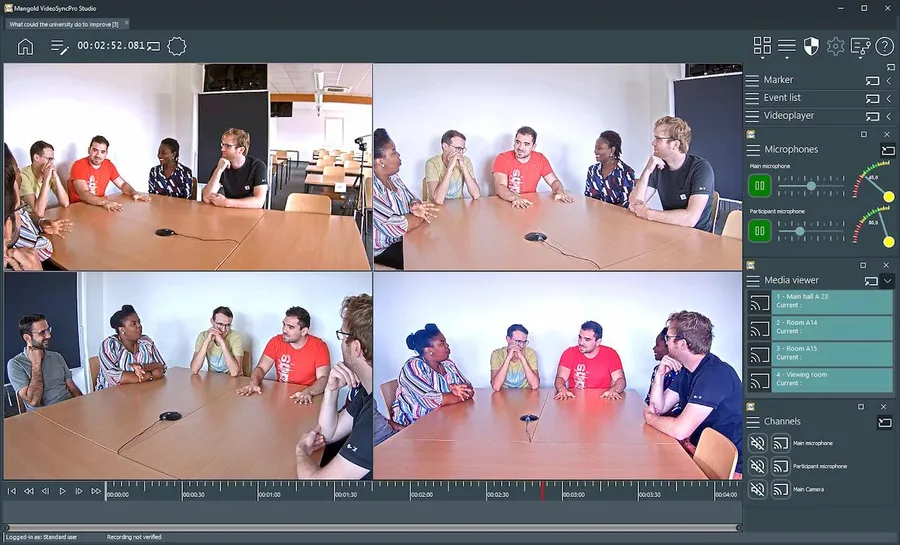
The single biggest technical challenge in running a focus group facility is synchronously recording multiple audio, video and data sources. Even slight timing offsets between cameras or microphones lead to misinterpretation during analysis – for example, when it’s unclear which reaction belongs to which stimulus image. Marketing-relevant emotions often occur within sub-second windows. Synchronization is therefore not a nice-to-have – it’s a precondition for valid results.
Mangold VideoSyncPro is built precisely for this:
- simultaneous recording from multiple video sources for complete room coverage,
- simultaneous capture from multiple audio sources with flexible mixing,
- remote control of PTZ cameras (pan, tilt, zoom) during live sessions,
- synchronization with external devices such as eye trackers and physiological sensors,
- real-time markers and comments during recording, serving as jump-points for later analysis,
- automated stimulus presentation for structured tests.
For market research, this means the moderator can focus entirely on the group while the technology runs reliably, synchronously and fully documented in the background.
Mangold Observation Studio: Multimodal Data Capture in One Platform
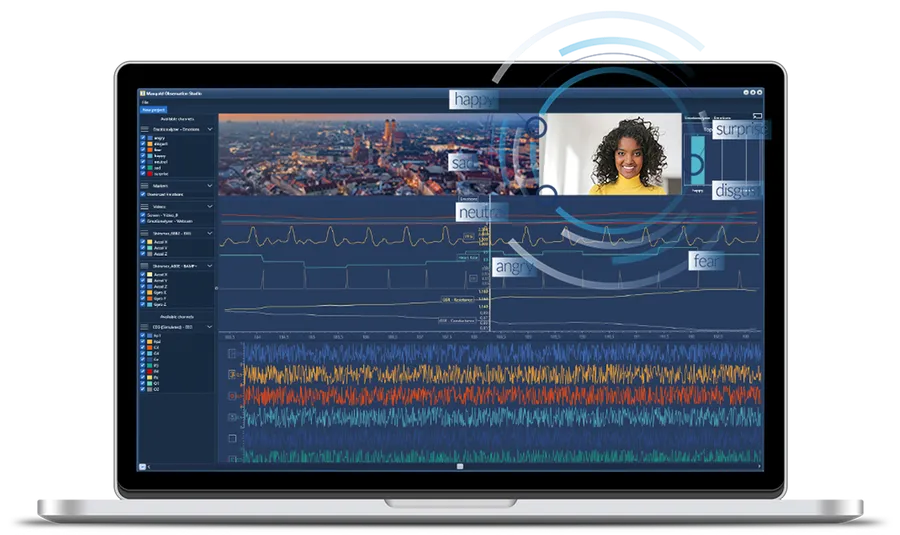
Researchers who go beyond classic focus groups – capturing behavior multimodally through video, audio, screen content, eye tracking, facial expressions and physiology at the same time – need a single platform to manage all of those data streams in sync.
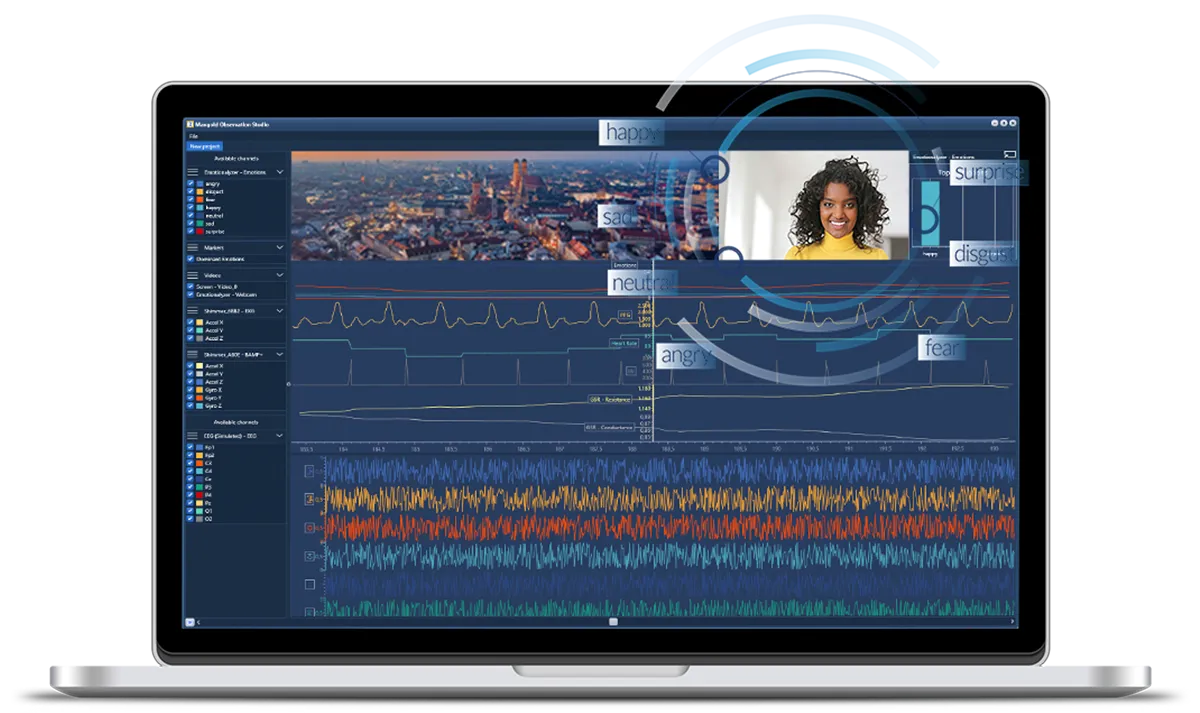
Mangold Observation Studio is that platform. Its central management interface records, stores and analyzes data streams from cameras, microphones, eye trackers, GSR and ECG sensors, screen recordings and more – all in perfect synchronization.
Key strengths in a focus group facility context:
- Modular architecture: Configured precisely to project requirements – from a simple focus group to a complex UX study with eye tracking and biosignals.
- AI-driven emotion analysis: The built-in Emotionalyzer module automatically detects basic emotions from recorded facial expressions.
- Physiological analysis: Heart rate variability from ECG and arousal state from skin conductance (GSR) provide objective, non-verbal data.
- API/SDK integration: Connect to additional systems and sensors.
This makes Observation Studio a central tool for advanced studies in market research, UX, consumer research, psychology and behavioral science.
Mangold Observation Studio
The advanced software suite for sophisticated sensor data-driven observational studies with comprehensive data collection and analysis capabilities.
Mangold INTERACT: Professional Focus Group Analysis
Once the recording is complete, the real research work begins: structured analysis. Mangold INTERACT is a software platform for the professional analysis of audio and video material, built specifically for behavioral and observational research.
For focus group analysis, INTERACT offers decisive advantages:
- Multiple videos in parallel: Open the group wide shot and a participant close-up at the same time, with perfect time synchronization preserved.
- Flexible coding system: Systematically classify statements, reactions and behaviors using categories you define.
- Statistical analysis: Frequencies, durations, co-occurrences and patterns – qualitative observations become quantifiable results.
- Marker import from VideoSyncPro: Markers set during recording dramatically speed up the analysis workflow.
- Reliability analysis: Inter-rater reliability for scientifically defensible studies.
INTERACT turns qualitative observations into quantifiable insights – revealing behavioral patterns that live observation alone cannot detect.
MangoldVision: Eye Tracking for Advertising, Packaging and Usability Tests
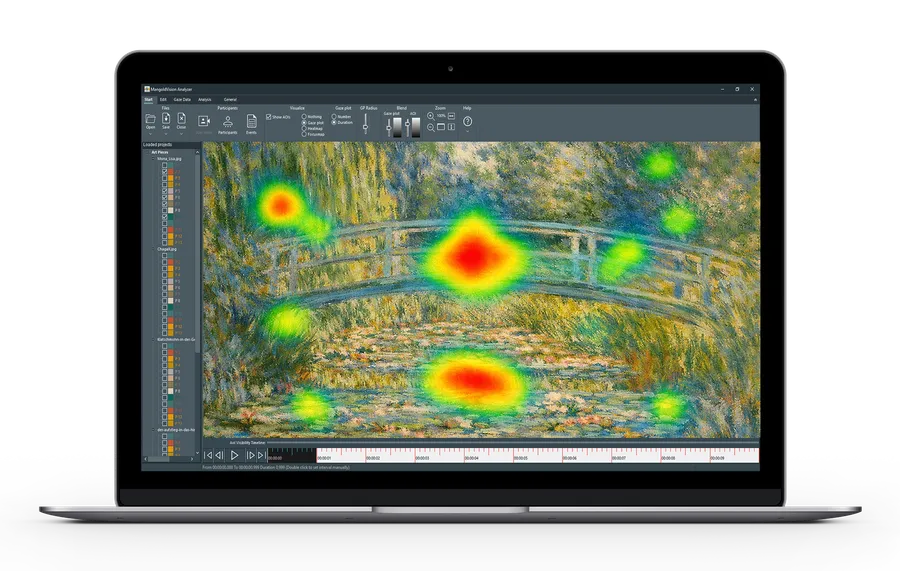
Many study types in a focus group facility benefit enormously from eye tracking. Which areas of a package do shoppers actually look at? Which ad elements draw the eye? Where do users get lost on a website?
MangoldVision is Mangold International’s eye-tracking solution – a complete system of software and compatible eye-tracking hardware that integrates seamlessly into any focus group facility.
Core capabilities for market research and UX:
- Stimulus presentation for images, videos, websites, screen recordings, and E-Prime or SuperLab projects.
- Heatmaps and gaze plots that visualize attention distribution.
- Area-of-Interest (AOI) analysis: statistical metrics for fixation duration, order and frequency per defined area.
- Full user-experience capture: alongside gaze data, the system records screen, facial expressions, mouse activity, keystrokes and think-aloud protocols.
- Mobile-ready: the compact eye tracker works with various monitors and laptops – ideal for portable focus group setups.
Eye tracking grants insights into visual cognition that classic observation, questionnaires and interviews simply cannot reach.
Which Mangold System for Which Study Type?
| Study type | Primary software | Complementary software |
|---|---|---|
| Classic focus group | VideoSyncPro | INTERACT |
| Multimodal UX study (bio, eye, video) | Observation Studio | INTERACT, MangoldVision |
| Advertising, packaging or website testing | MangoldVision | Observation Studio |
| In-depth interview (IDI) | VideoSyncPro | INTERACT |
| Concept test with emotion measurement | Observation Studio | MangoldVision, INTERACT |
Use Cases: What a Focus Group Facility Is Used For
A professionally built focus group facility supports a wide range of qualitative research methods:
| Application | Typical method | Key requirements |
|---|---|---|
| Focus groups | Moderated group discussion | Multi-channel audio, live viewing, synchronized video recording |
| Product testing | Observation during product use | Multiple cameras for different angles on product and user |
| Usability research | Think-aloud, task observation | Screen recording, eye tracking, optional physiology |
| In-depth interviews (IDI) | One-on-one interview | Discreet AV setup, premium audio quality |
| Concept tests | Reaction to stimuli | Stimulus presentation, reaction measurement, eye tracking, emotion analysis |
| Design thinking & co-creation | Creative workshops | Group observation, whiteboard camera, high participant mobility |
| Sensory research | Taste, smell, product tests | Specialized room design, often participant-led documentation |
Step by Step: How to Build a Focus Group Facility
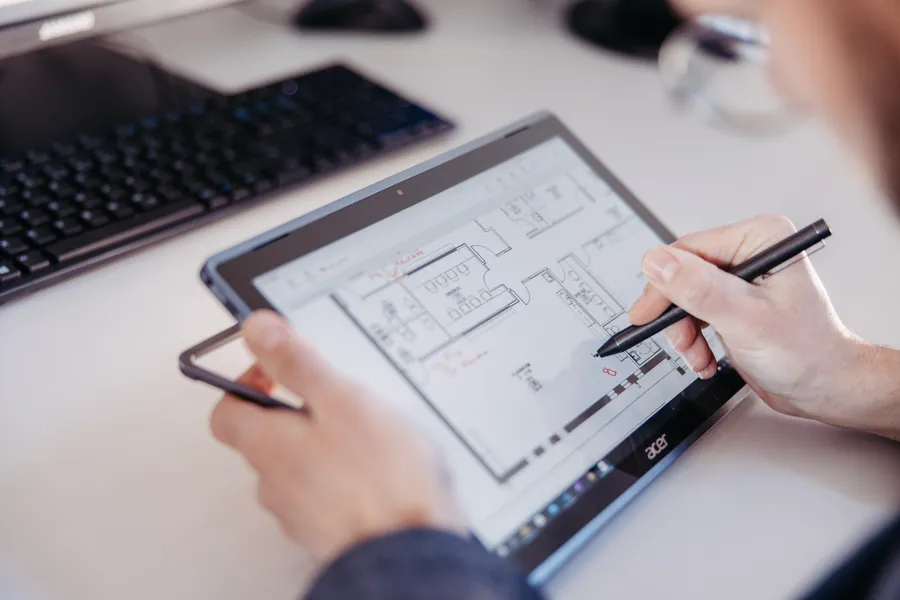
Step 1 – Needs Analysis and Study Design
Before ordering a single camera, clarify the research requirements:
- Which study types will run in the facility?
- How many participants need to be observed simultaneously?
- Does the facility need to be permanent or portable?
- Are eye tracking or physiological sensors required?
- What GDPR and client-side compliance standards apply?
Mangold International offers a complimentary expert planning service at this stage. Based on over 35 years of experience, Mangold engineers typically deliver a tailored lab design within just a few days.
Step 2 – Room Layout and Construction Prep
The discussion room should encourage participant openness – through a living-room feel or neutral atmosphere, pleasant lighting and proper sound insulation. Three construction considerations matter most for the technical install:
- Wall pass-throughs and cable channels for clean, unobtrusive cabling,
- Power outlets at planned camera locations,
- Network infrastructure (preferably gigabit Ethernet) between discussion room and observation room – even when those rooms are in different parts of the building.
Unlike the classic two-way mirror approach, the two rooms do not need to be adjacent. A single network cable handles all audio and video streams.
Step 3 – Camera and Microphone Installation
In a permanent facility, PTZ cameras are mounted on walls or ceilings and connected to the control workstation over the network. Camera placement follows the principle of maximum room coverage:
- a wide-angle camera for the full group,
- detail cameras for the moderator and individual participants,
- optionally a top-down camera above the table for product or material tests.
Microphones – ceiling, boundary or lavalier, depending on requirements – are placed for complete room coverage with no dead zones.
Step 4 – System Integration and Software Setup
The heart of the installation is system integration. All cameras, microphones and external devices connect through a central network switch to the recording workstation. Mangold VideoSyncPro is configured as the recording and control software. For multimodal study designs, Mangold Observation Studio extends the stack with eye tracking, screen recording and biophysiological sensors.
Before going live, the entire system is fully tested, calibrated and validated in a realistic dry run.
Step 5 – Quality Assurance and Product Training
Every Mangold system goes through rigorous internal testing before delivery to ensure smooth operation from day one. After delivery, your team receives personalized product training on the recording software (VideoSyncPro, Observation Studio), on data analysis with INTERACT and – where applicable – on running studies with MangoldVision . The result: a facility that is not just technically operational, but operationally ready.
Data Protection: GDPR Compliance in a Focus Group Facility
Any focus group facility that records people on audio and video falls under the General Data Protection Regulation (GDPR). Required:
- written consent from participants before recording,
- transparent information about purpose and scope,
- secure storage with access controls,
- defined retention periods and audit-proof deletion.
Modern facility software like Mangold VideoSyncPro and Mangold Observation Studio ships with built-in GDPR-compliant recording management – including automated anonymization options for faces and other identifying features.
The Bottom Line: A Modern Focus Group Facility as Competitive Advantage
A professionally built focus group facility is far more than a room with a two-way mirror and a camera. It is an integrated research infrastructure that takes qualitative market research and behavioral research to a new level of quality.
With the right combination of:
- thoughtful room design,
- professional audio-video equipment,
- synchronized recording with Mangold VideoSyncPro ,
- multimodal data capture with Mangold Observation Studio ,
- eye tracking with MangoldVision , and
- systematic analysis with Mangold INTERACT ,
every focus group, product test and usability study yields insights that traditional methods leave on the table.
Whether you build a permanent market research facility or a portable system for field studies, the investment pays back through better data quality, faster analysis and more convincing results for your clients.
Mangold AV Observation Labs
Mangold AV Observation Labs are comprehensive turnkey solution for conducting behavioral research and observation.