
Know-How · 10 min read
Focus Group Analysis: Traditional vs. Video-Based Methods
Traditional vs. video-based focus group analysis: methodological rigor, nonverbal data, inter-rater reliability and total cost of process compared.


Anyone aiming to analyze focus groups in a methodologically defensible way should be aware of the quiet shift that has been reshaping qualitative research in recent years. Traditional focus group analysis relies on audio transcripts, handwritten notes and live observation behind a two-way mirror - and the findings it produces depend structurally on the individual perception of observers in real time. Video-based methodology uses synchronously recorded video and audio material as an objective data store and makes qualitative research reproducible in ways that audio-only transcripts cannot achieve.
This article compares both approaches along the criteria scientific reviewers and clients use to evaluate qualitative studies: data foundation, reliability, validity, analytical depth - and quality-adjusted cost. You will see why the video-based approach scores higher across all five quality dimensions of qualitative research at the same time, how this can be expressed as a quantifiable efficiency metric, and when each methodology is scientifically justified - differentiated by screen-based studies and studies in physical rooms.
How traditional focus group analysis and video-based focus group analysis differ in data foundation, methodological rigor, reproducibility and analytical depth – and why the video-based approach has become the scientific gold standard.
Focus Group Analysis in One Sentence
Focus group analysis is the systematic evaluation of moderated group discussions to capture attitudes, perceptions and behavioral patterns of a target audience – either traditionally, based on audio transcripts and live observation, or video-based, using multimodal recordings and reproducible detail analysis.
Which of the two methods meets the demands of modern qualitative research is a question of methodological rigor. This article compares both approaches along the same criteria scientific reviewers and clients use to evaluate qualitative studies: data foundation, reliability, validity, analytical depth – and quality-adjusted cost.
Traditional Focus Group Analysis
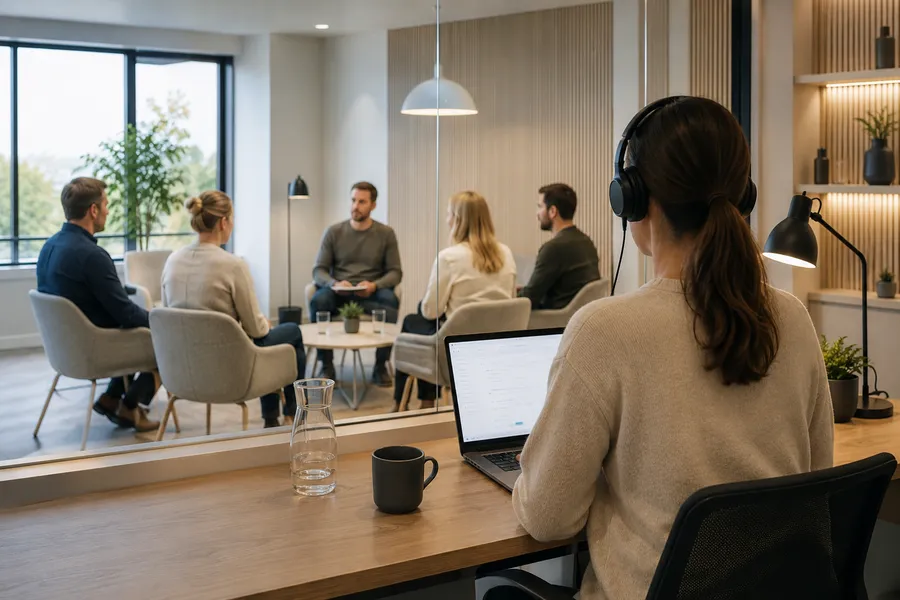
The traditional focus group relies on direct interaction between a moderator and a group of typically five to twelve participants. Data is captured through:
- audio recordings of the discussion,
- handwritten notes by the moderator,
- live observation by researchers behind a two-way mirror in the adjacent room.
Methodological Approach and Data Analysis
Analysis in the traditional model is based primarily on transcribed audio recordings, which are then coded using qualitative content analysis or thematic coding. The analytical focus sits on what was said. The how – nonverbal communication, micro-expressions, group dynamics – is captured only rudimentarily through the subjective impressions of observers, which is a cognitively demanding task for the observers themselves.
Documented Limitations of the Traditional Method
Three structural weaknesses of the traditional approach are well documented in the methodological literature:
1. Loss of nonverbal information. A substantial share of human communication is nonverbal. Audio-only transcripts strip away critical information: facial expressions, gestures, posture, eye contact and subtle interactions between participants. Manual notes cannot close this gap because of basic cognitive capacity limits of the observers – no human can observe several participants at high attention while simultaneously protocoling verbal content and nonverbal signals in a valid way.
2. Observer bias and two-way mirror effects. The mere physical presence of a two-way mirror can influence participant behavior. Research suggests that mirrors increase self-awareness, which encourages socially desirable behavior. On top of that, observers behind the mirror are subject to their own cognitive biases – they have to interpret events in real time, without the option to pause or replay.
3. Limited inter-rater reliability. Because analysis depends heavily on the impressions of the researchers present at the session, achieving high inter-rater reliability – the agreement of multiple independent coders – is structurally difficult. Reconstructing actual group dynamics from text transcripts alone leaves substantial room for subjective interpretation. The traditional method therefore fails on precisely the criterion that scientific reviewers treat as a quality benchmark for qualitative research.
Video-Based Focus Group Analysis
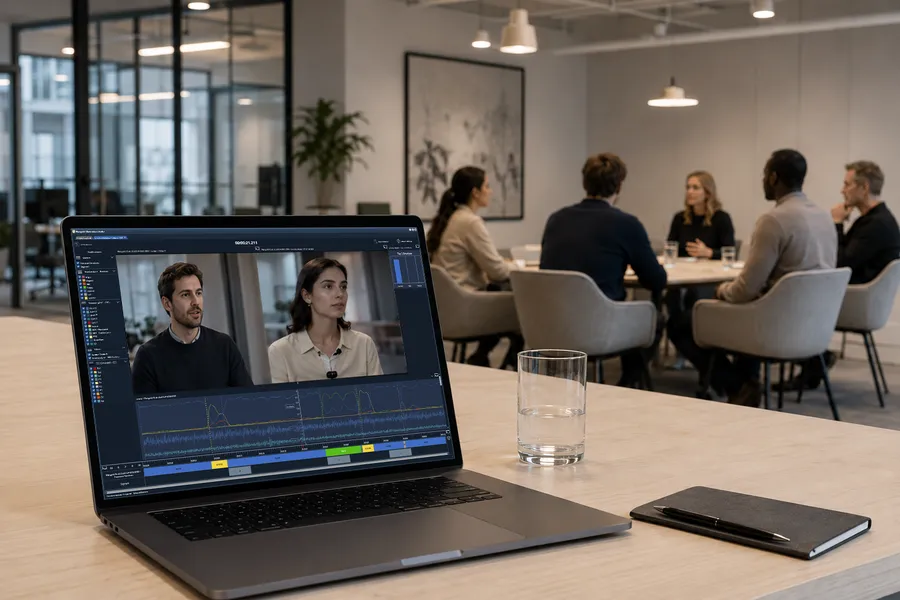
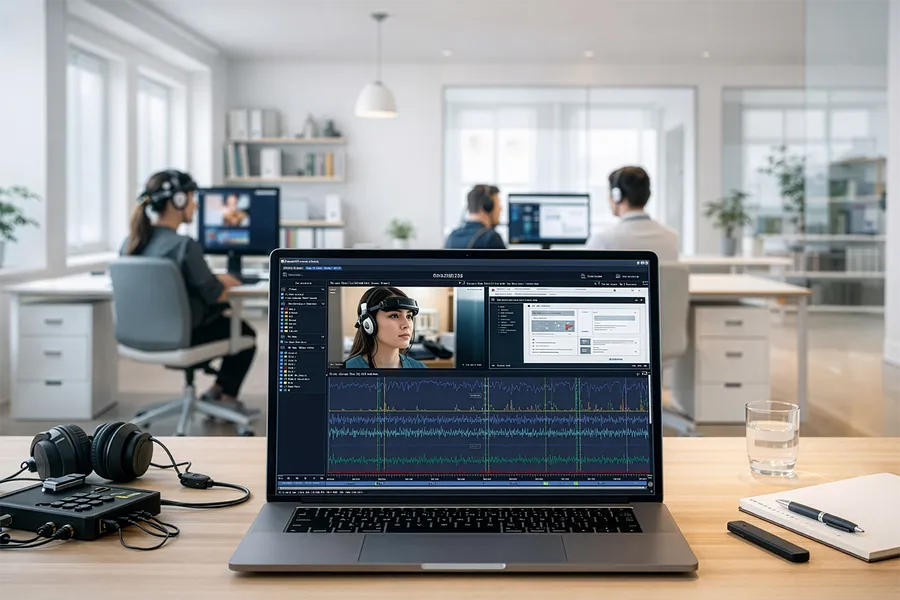
Video-based methodology uses modern recording systems – for example Mangold VideoSyncPro – to capture the session from multiple angles in full synchronization. This creates two fundamentally new capabilities:
- live observation on monitors in a separate observation room, without the need for a two-way mirror, and
- deep retrospective analysis based on complete, replayable recordings.
Methodological Approach and Data Analysis
Video-based analysis expands the data spectrum substantially. Researchers can replay recordings, pause and code specific sequences in detail. The result is a multimodal analysis that integrates:
- verbal statements (word choice, content),
- prosodic features (tone, volume, pauses),
- nonverbal signals / kinesics (facial expressions, gestures, posture),
- group dynamics (eye contact, turn-taking, reactions to one another).
Scientifically Relevant Advantages of Video Analysis
1. Capturing the micro-level. Subtle nonverbal cues that are missed in real time can be extracted precisely from recorded material. Research consistently shows that nonverbal communication is essential to grasp the true meaning and emotional resonance of statements. Video analysis also allows researchers to quantify parameters such as interpersonal movement synchrony – an established indicator of rapport and active listening. Fleeting emotional reactions like surprise, joy or disgust appear as micro-behaviors that are nearly impossible to capture reliably in real time.
2. Increased methodological rigor. Video recordings act as an objective data store. Multiple researchers can code the same session independently – which makes calculating and securing high inter-rater reliability dramatically easier. Disagreements in interpretation can be discussed and resolved transparently by reviewing the relevant video sequence together.
3. Integration of AI and automated tools. The availability of video data opens the door to specialized analysis software like Mangold INTERACT – including automated transcription with speaker identification. Used correctly, Mangold INTERACT enables efficient and effective structured behavioral coding and statistical evaluation of these recordings. The combination of AI-driven transcription and behavioral coding enriches the analytical process and frees it from subjective routine judgments.
4. Reduction of observer effects. Discreetly placed cameras create a more natural discussion atmosphere than a dominant two-way mirror. The ecological validity of the data rises – participants react closer to how they would react outside the study setting.
5. Synchronized integration of physiological data. When biosignals such as GSR (galvanic skin response) are used to measure arousal, exact temporal alignment between event and reaction is essential – GSR typically shows a response 2–5 seconds after the triggering event. Valid interpretation therefore requires backward analysis of a recorded sequence. Physiological data can substantially enrich the verbal and nonverbal dataset because they make the inner processes of participants visible – the things participants neither say nor show. Mangold Observation Studio captures signals from biophysiological sensors with millisecond accuracy and makes precisely this kind of analysis possible.
Traditional vs. Video-Based: The Direct Comparison
The following table summarizes the core differences along the criteria that make qualitative research scientifically defensible:
| Criterion | Traditional Focus Group Analysis | Video-Based Focus Group Analysis |
|---|---|---|
| Data foundation | Limited to what observers can perceive in real time | The full session with all nuances, depending on camera and microphone setup |
| Primary data source | Audio transcripts, observer notes | Multimodal video and audio recordings |
| Capture of nonverbal cues | Low, depends on real-time focus | Very high, replayable detail analysis |
| Inter-rater reliability | Hard to validate, often subjective | High, since raw data is available for independent coders |
| Analytical options | Text and content analysis | Behavioral, interaction and automated AI analyses |
| Ecological validity | Potentially impaired by two-way mirror | Higher through discreet camera technology |
| Time investment | High (manual transcription and coding) | Higher upfront, significantly accelerated by AI tools |
| Quality of findings | Subjective, bounded by personal memory and perception | Objectively reproducible, derivable from the recordings at any time |
| Volume of insights | Limited to what was captured live | Effectively unlimited through repeated analysis under different angles |
| Physiological integration | Not meaningfully feasible (time offset cannot be reconstructed) | Fully integrable (millisecond-accurate synchronization) |
| Marker workflow | Not available | Live markers for key events, with jump-to-sequence in offline analysis |
The decisive difference is not a single feature – it is a shift in evidentiary basis: the traditional method produces findings that depend on the individual perception of the observers. The video-based method produces findings that are defensible from the recorded data itself.
Total Cost of Process: Higher Cost ≠ Lower Economic Value
A common assumption holds that video-based focus groups are more expensive than traditional ones. At the pure process-cost level, this is often true – the detailed analysis, the setup and the software all generate additional effort. The decisive question, however, is not “what does the method cost?” but “what does one unit of insight cost?”.
The Cost Formula in Quality-Adjusted Comparison
Process cost can be expressed as the sum of all role-based and material cost components:
K_Process = Σ (n_i × h_i × s_i) + K_Room + K_Tech + K_Software + K_Transcript
            + K_Report + K_QA + K_Overhead
with n_i = number of people per role, h_i = hours per role, s_i = hourly rate per role.
The comparison only becomes methodologically defensible when process cost is set in relation to the quality of insight delivered:
K_effective = K_Process / Q

where
Q = w₁·D + w₂·N + w₃·R + w₄·O + w₅·E

D = depth of data
N = capture of nonverbal cues
R = reproducibility / inter-rater reliability
O = objectivity
E = volume / breadth of insight
w₁…w₅ = weighting
In this framework, the comparison is no longer between two cost figures – it is between two efficiency metrics:
K_effective,traditional = K_traditional / Q_traditional
K_effective,video       = K_video       / Q_video
In typical research settings, the video-based focus group methodology delivers a significantly higher Q, because it scores higher across all five quality dimensions at the same time. Even at higher process cost, the video-based focus group methodology frequently produces a better quality-adjusted cost position – because fewer sessions are needed to support defensible conclusions and existing recordings can be re-analyzed under new research questions.
The Mangold Stack for Video-Based Focus Group Analysis
A valid video-based focus group analysis requires two coordinated software layers: one for synchronized data capture and one for structured analysis. Mangold International covers both layers with a deliberately aligned product family.
Mangold VideoSyncPro – Synchronized Recording
Mangold VideoSyncPro is the professional software for millisecond-accurate, synchronized recording of audio, video and marker data. It enables:
- simultaneous recording from multiple camera angles,
- multi-channel audio capture,
- remote control of PTZ cameras during the session,
- real-time markers for key moments that can be jumped to directly during offline analysis.
This focuses the analytical workflow on key events – a substantial efficiency gain compared to linear playback of full recordings.
Mangold INTERACT – Structured Analysis
Mangold INTERACT is the platform for the scientific evaluation of recorded material:
- multiple videos in parallel with preserved time synchronization,
- a flexible coding system for statements, reactions and behaviors,
- built-in reliability analyses for inter-rater agreement,
- automated transcription with speaker identification,
- statistical analysis of frequencies, durations and co-occurrences.
Mangold Observation Studio – Multimodal Data Integration
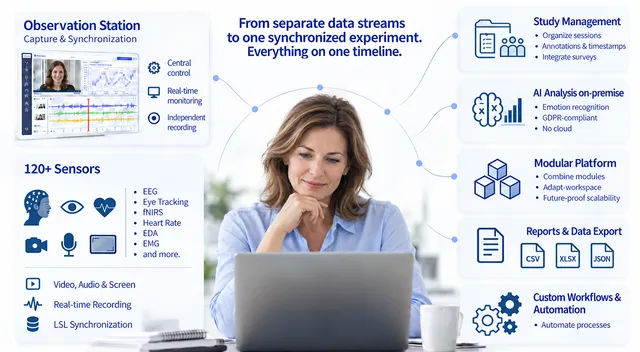
Where physiological data or eye tracking enters the study design, Mangold Observation Studio integrates all sensor data streams – GSR, ECG, eye tracking, screen recording – into a single, synchronously managed platform. The built-in Emotionalyzer module adds AI-driven emotion detection from recorded facial material to the analytical toolkit.
Mangold Observation Studio
The advanced software suite for sophisticated sensor data-driven observational studies with comprehensive data collection and analysis capabilities.
MangoldVision – Eye Tracking Extension
For stimulus-driven studies (advertising, packaging or website testing), MangoldVision contributes eye tracking data including heatmaps, gaze plots and Area-of-Interest analysis – fully integrable into the same analytical ecosystem.
Which Method When? A Clear Decision Guide
Study at a Computer Screen
Participants are presented with a series of predefined stimuli on a PC screen for concept, advertising or UX testing.
| Situation / Research Task | Recommendation |
|---|---|
| Attention studies with Areas of Interest and gaze-path analysis | MangoldVision software + eye tracking hardware |
| Studies with physiological measurement and emotion analysis | Mangold Observation Studio + physiological sensors, optionally eye tracking hardware |

Study in a Physical Room
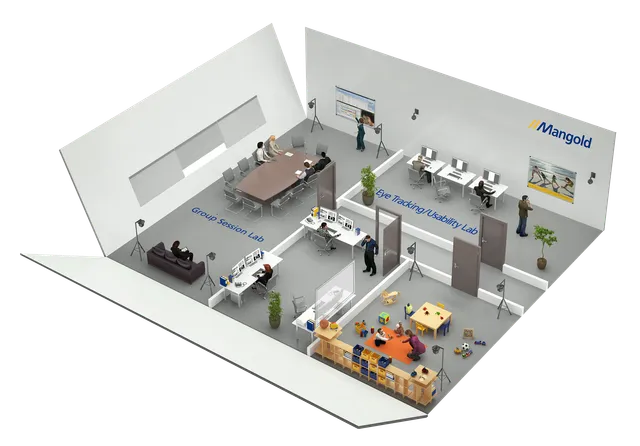
Participants discuss topics or real objects in the room (e.g. packaging tests). A suitable infrastructure is a stationary Mangold audio-video lab or a portable observation lab for on-site studies at the client’s location.
| Situation / Research Task | Recommendation |
|---|---|
| Quick, exploratory discussion without scientific claims | Traditional focus group is sufficient |
| Defensible qualitative insights for strategic or product decisions | Video-based analysis (AV equipment + Mangold VideoSyncPro + Mangold INTERACT) |
| Studies with key nonverbal data (emotion, physiology) | Video-based analysis + Mangold Observation Studio |
| Re-analysis of the same material under shifting research questions | Video-based mandatory (not possible traditionally) |
The Bottom Line: Video-Based Is the Modern Gold Standard
The comparison makes clear that video-based focus group methodology is superior to the traditional approach across four central dimensions:
- methodological rigor through reproducible analysis,
- data depth through capture of nonverbal and multimodal data,
- objectivity through replayable detail analysis,
- breadth of insight through repeated analysis of the same material.
The traditional method remains useful for low-stakes, exploratory settings. But for any study whose findings have to support strategic decisions, withstand scientific publication or pass client audits, video-based analysis is today’s gold standard – not despite its higher methodological demands, but because of them.
The investment pays back economically as soon as cost is set in relation to quality: more insight per euro, more reproducibility per session, more defensible conclusions per study.
Mangold AV Observation Labs
Mangold AV Observation Labs are comprehensive turnkey solution for conducting behavioral research and observation.